Institutional knowledge is the missing layer in most contact center AI data strategies
Derek Brameyer
Head of Application Engineering

Key takeaways
- The most valuable knowledge in any contact center lives in two places: its call transcripts, and the instincts of top-performing agents. Almost none of it reaches the AI systems meant to help every agent perform.
- Most transcript analysis is built to catch what went wrong, not to understand what drove results. A structured annotation layer, tied to verified business outcomes, turns interaction data into a map of what actually works.
- Tying that annotation to verified operational data rather than AI-inferred outcomes is what makes the intelligence reliable enough to act on. An AI guessing at outcomes introduces noise that compounds at scale.
- When AI copilots are built on annotated, outcome-tied data, they shift from generic best practices to guidance tailored to the specific customer and moment. Early results show that this can improve both sales conversion and retention.
You already know that your contact center AI is only as strong as the data behind it. What is less obvious is where that data comes from and what it’s missing.
Every contact center generates enormous volumes of interaction data every day. Volume is not the problem. The problem is that almost none of that data is structured, annotated or tied to verified outcomes in a way an AI system can use. In fact, the most valuable knowledge in your operation is rarely captured in any system at all. It’s buried in transcripts that have never been properly analyzed, and in the instincts of high performers who have never been asked to explain what they do or how they do it.
That has a cost. In research published in April 2026, Gartner found that 38% of AI leaders cite poor data quality or limited data availability as a direct cause of AI project failure. In my view, that is because too often the data they’re feeding their models does not accurately reflect how their people actually work.
This article looks at why this gap exists and what it takes to close it. I’ll cover what institutional knowledge is and why it rarely reaches your AI systems, what a proper data annotation foundation looks like and what becomes possible once it's in place.
Your contact center has an institutional knowledge problem, and it is expensive
A colleague of mine, Jim Mitchell, vice president of customer experience and digital innovation at TELUS Digital, once described visiting a logistics company’s contact center and noticing something during a side-by-side with one of their agents.
Mid-call, the agent quietly slid open a desk drawer. Inside was a set of ad-hoc spreadsheets listing the most common question and answer pairs customers posed. He had been there for years; so had the spreadsheets.
The company’s official knowledge base was too vast to navigate under pressure, so agents had been passing around their own cheat sheets for as long as anyone could remember. Policy didn’t allow it. They did it anyway because it worked and they had targets to hit. Jim shared this story on an episode of the TELUS Digital podcast, Questions for now, titled “How can brands design and deliver seamless customer experiences?”
The drawer is not an anomaly. It is what institutional knowledge looks like when an organization has no way to capture it. According to Panopto’s Workplace Knowledge and Productivity Report, 42% of an employee’s working knowledge is entirely unique to them. It is learned on the job, shared with no one and never codified. The moment that agent leaves, it walks out the door with them.
In a contact center, where attrition is traditionally high and interaction volume is considerable, that cost compounds in several ways:
- High performers leave and take their techniques with them. The best objection handling and the sharpest discovery questions exit with the people who developed them.
- New agents have no structured way to learn what actually works. They inherit the official script, not the floor-tested moves that beat it.
- Leadership makes blind decisions about scripts and positioning. Without visibility into what’s driving results at the point of contact, those decisions are guesswork.
The knowledge that drives your best outcomes is being generated every single day. Most of it simply disappears.
Without a feedback loop, agent knowledge cannot improve your contact center AI
Too often, contact centers have no AI data strategy or structural mechanism to move floor-level knowledge upstream.
When a top-performing agent figures out a better way to handle a common objection, it might get shared with the person at the next desk or surfaced briefly in a team meeting. It rarely makes it into training materials, scripts or AI tools that are supposed to be helping every agent on the floor perform at their best.
This is why contact center AI can underperform. AI is only as strong as the domain context it has access to. Starve it of specific knowledge about what works in your environment, and it produces generic outputs, which experienced agents quickly learn to ignore. The impact on AI agent performance across the contact center is direct. When agents can’t trust their tools to reflect how their world actually works, the floor underperforms as a whole, not just newer hires.
Forrester named tacit knowledge as the defining challenge for AI-led contact centers, arguing that without a deliberate approach to capturing it, harnessing its full potential will take years.
Closing the gap starts with understanding what your interaction data actually contains. And that requires annotation.
Annotating contact center transcripts is what turns data into understanding
In my experience, transcript analysis programs tend to be built for quality assurance and compliance. They catch what went wrong, but do not capture what drove results.
A sentiment score, for example, tells you a customer was frustrated; it does not tell you whether the agent’s next move made things better or worse, which technique turned the call around, or whether that technique works the same way across similar situations.
A structured annotation layer is the foundation of genuine conversation intelligence in the contact center. Instead of flagging surface-level signals, it classifies every turn of a conversation against a detailed taxonomy and ties each one to verified business outcomes. Run that across thousands of interactions and a transcript becomes a map of what drives results, rather than a record.
What contact center transcript annotation looks like at scale
Annotation at scale means every turn of every conversation is classified through call center transcript analysis against a structured taxonomy, with human validation to ensure that the output is accurate enough to act on.
The table below shows the key dimensions an annotation taxonomy should cover and what each one captures.
Annotation category | What it captures |
|---|---|
Conversation stage | Where in the interaction each exchange falls: greeting, discovery, solutioning, pitch, objection, close or wrap-up |
Agent intent | The functional purpose of each agent turn: clarify, recommend, compare options, present price, de-risk or close |
Customer sentiment | How the customer is responding at each stage: receptive, hesitant, frustrated, disengaged or ready to buy |
Price sensitivity | Whether cost, budget constraints or competitor pricing comparisons are present, and how much resistance they signal |
Empathy quality | Whether empathy is absent, generic, context-aware or personalized and specific to the customer’s actual situation |
Agent positioning | Whether the agent is reactive, responding to what the customer raises, or proactive, anticipating needs and leading toward a solution |
Offer framing | How a product is positioned: value-first, price-first, emphasizing savings, explaining bundle advantages or responding defensively to resistance |
Bridge quality | How cleanly the agent transitions from resolving an issue to introducing a new product: abrupt, neutral, generic, contextual or seamless |
Objection handling | Whether objections are resolved, partially resolved or unresolved, and the technique used to handle them |
With that dataset, you can ask questions that were previously out of reach:
- What do the top 15% of retention calls look like at the turn level, and what are agents in the bottom half doing differently?
- Which objection handling approaches correlate with successful outcomes, and at what stage of the conversation do they matter most?
- Are agents who use value-first offer framing outperforming those who default to price-first, and by how much?
- Where in the conversation do most save attempts break down?
Human validation is not optional here. AI does the annotation at scale, but expert review confirms accuracy and alignment with brand and compliance standards before any of it is activated. That’s what our Humanity-in-the-Loop philosophy is all about.
With full customer context, your contact center AI stops giving generic guidance
This is where the work pays off in ways that are hard to match.
Most agent copilots run on general best practices. They surface a suggested response based on keywords, sentiment triggers or broad interaction patterns. That’s useful up to a point. But it means every agent gets roughly the same guidance, regardless of who is actually on the other end of the call, what that customer’s history looks like or where the conversation has gone in the last three minutes.
Annotation changes that from general to specific. When a copilot is built on data annotated at the turn level and tied to verified outcomes, it can start to factor in the full picture. The guidance it surfaces reflects what actually works, not what the training manual says should work.
When I spoke with our Global Vice-President of TELUS Global Operations Excellence, Jelena Bajic, she described the operational significance of this directly. “What if your best team members’ expertise wasn’t just their personal competitive advantage — it was everyone’s? When knowledge from your top performers gets shared and adopted across the team, customer experience lifts. Value gets created. Full stop.”
Annotation tied to verified outcomes is what separates signal from noise
Not all annotation is equally useful. The quality of the intelligence your AI draws on depends entirely on how the underlying data was labeled and what it was labeled against.
A common shortcut is to use AI to infer whether a call was successful. Did the customer sound satisfied? Did the agent hit the right keywords? This is the “LLM-as-a-judge” pattern, and while it's an approach that has its uses, it introduces noise that compounds as your dataset grows. An AI inferring outcomes is making educated guesses. Verified operational data — confirmed sales events, logged retention outcomes and recorded escalations — is ground truth, not guesswork.
Consider what that looks like in practice. An agent uses a seamless bridge after resolving a billing issue, frames a new product around the customer’s stated needs rather than its price, handles a hesitation with a structured reframe, and crucially, the customer converts. Outcome-tied annotation labels that entire sequence — every turn, every technique, every framing choice — against the confirmed sale in your operational system. It becomes a verified winning pattern, not an inferred one.
The distinction matters because knowing a sale happened is different from knowing what drove it. Outcome-tied annotation answers both questions, attributing results to specific behaviors, language patterns and conversation sequences. That is the foundation your AI needs to give guidance worth following.
The feedback loop that makes your contact center AI smarter over time
The organizations that I see get the most from this approach treat annotation as a continuous effort, one that grows more precise as more interactions are captured, annotated and tied to outcomes.
When AI-powered agent copilot interaction logs are correlated with call transcripts and verified business outcome data, every interaction becomes a data point. You see not just whether an agent used the copilot, but which suggestions they adopted, which they ignored and what happened as a result. That enables you to refine the guidance continuously, retiring what isn’t working and reinforcing what is.
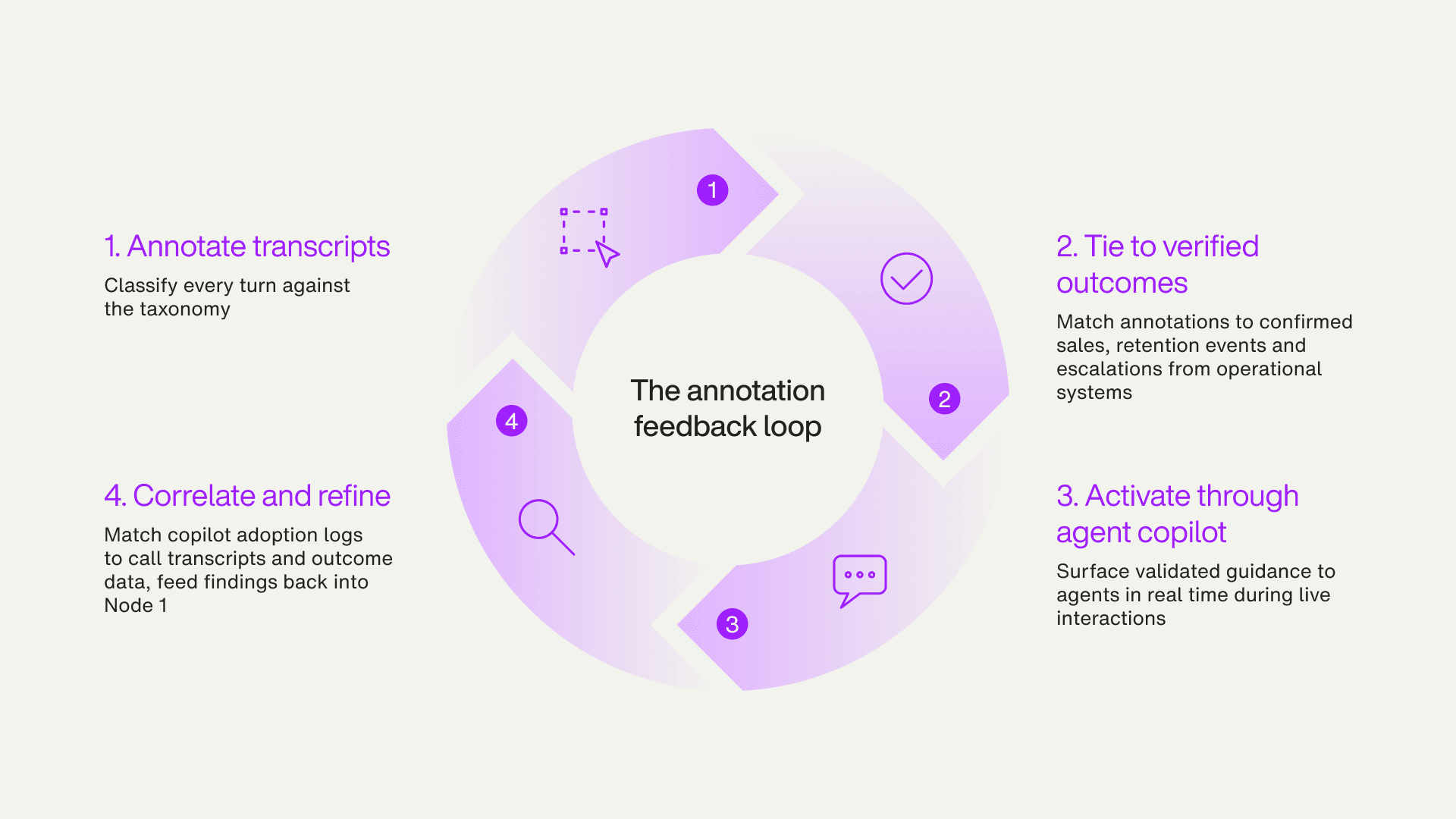
Early results from our work for TELUS, a world-leading communications technology company and our parent organization, show meaningful directional improvement in first contact resolution, sales conversion and retention when agents adopt copilot suggestions grounded in this kind of intelligence. “Here’s what we've learned: When your frontline teams and your development teams are working side-by-side with real visibility into what’s happening on the floor, that's when the magic happens. The improvement cycle accelerates because you're building solutions together in real time. That’s how value gets created,” added Bajic.
TELUS Digital’s operator advantage is yours to leverage
Our relationship with TELUS gives us an advantage that can become yours. We saw an opportunity to improve our own customer experience with AI grounded in what our best agents actually do, and we had the technology ecosystem and the operational scale to act on it.
So we did.
We built and refined our annotation approach inside a real, large-scale telecommunications operation, across multiple queues and geographies, against verified outcome data from millions of customer interactions. Not as a pilot or a proof of concept, but as a production system that our agents use every day.
To date, that work includes annotating over 80,000 hours of call transcripts and standing up a continuous annotation pipeline that now powers agent copilot AI across TELUS. The behaviors of top-performing agents are being systematically identified, validated and made available to every agent on the floor. That is the voice of the call center, finally made legible to AI, regardless of an agent’s tenure.
It's our operator advantage in practice. We have lived it, iterated on it and measured it. And because we built it for ourselves, we understand the organizational, technical and human complexity involved in ways that inform every engagement we take on for others. Pure-AI vendors can build models. They can't train them on the kind of real conversation data, real outcomes and real feedback that comes from operating at scale inside a major telecommunications company. That is the difference.
If your contact center AI is producing generic guidance that agents are learning to ignore, the answer is almost certainly in your data. The intelligence you need is already there, in every transcript your agents have generated. It’s the kind of data pure-AI vendors cannot access. Data annotation is how you unlock it.
If you’re ready to put your interaction data to work, reach out to our team.
Derek Brameyer
Head of Application Engineering