How accessible email design drives better business results

Jess Daskal
Digital Marketing Manager
Key takeaways
- Email remains the premier engine for marketing ROI in 2026, consistently outperforming social media and search.
- Prioritizing accessible design expands a brand's reach to include the billions of people with disabilities who represent over $1 trillion in annual disposable income.
- Accessible communication streamlines navigation, creates a clear content hierarchy and improves the user experience for every recipient, regardless of ability.
- Transitioning to accessible email is a strategic evolution that requires integrating WCAG standards into foundational templates and establishing consistent testing protocols.
In 2026, email is still very much in the game. With 81% of companies counting it as a core part of their marketing strategy, the marketing channel's staying power is clear, yet most businesses overlook a critical question: How are our emails experienced by every member of our audience? Creating communications that everyone can access, understand and engage with, regardless of their abilities or the tools they use to read, shouldn’t be considered a nice-to-have feature.
The numbers tell a compelling story. Over 1.3 billion people globally live with some form of disability, and 285 million of them are visually impaired, relying on assistive technologies to navigate their digital world. That’s a significant portion of your potential audience.
Email accessibility is an essential aspect of effective business communication that reflects your organization’s commitment to inclusive design. For TELUS Digital clients, we audit existing assets, craft tailored web content accessibility guidelines (WCAG)-compliant templates and empower teams to build accessibility into every step.
Here's how we do it.
Web content accessibility guidelines and legal requirements
The benchmarks for digital inclusion evolved significantly in 2025, with the World Wide Web Consortium (W3C) establishing both clearer guidelines and stricter requirements. Built around four fundamental principles, web content accessibility guidelines continue to serve as the North Star, establishing that content should be:
- Perceivable: Users must be able to process information in digital experiences.
- Operable: Users must be able to access and operate websites and applications with a variety of tools.
- Understandable: Users must find digital experiences easy to comprehend, so that the connection between an action and the result should be obvious.
- Robust: Within limits, users should be able to successfully access websites across platforms, browsers and devices to account for personal choice and need.
On the legal front, the stakes have never been higher. The European Accessibility Act has set new global standards for digital communications, while compliance requirements of the Americans with Disabilities Act (ADA) have expanded to explicitly cover email communications. These updates reflect a global commitment to digital inclusion. Organizations that fail to meet these standards may not only face significant penalties but also reputational damage in an increasingly conscious market.
Key recommendations for accessible email design
Establishing a truly accessible email program requires a holistic focus on how content is perceived, navigated and understood by recipients.
Optimize visual design for accessibility
Visual design is the foundation of email accessibility, serving as the first point of interaction for all users. A well-designed email considers aesthetics, as well as how different users might perceive and interact with the content. The key is to create designs that are both beautiful and functional for everyone.
Best practices:
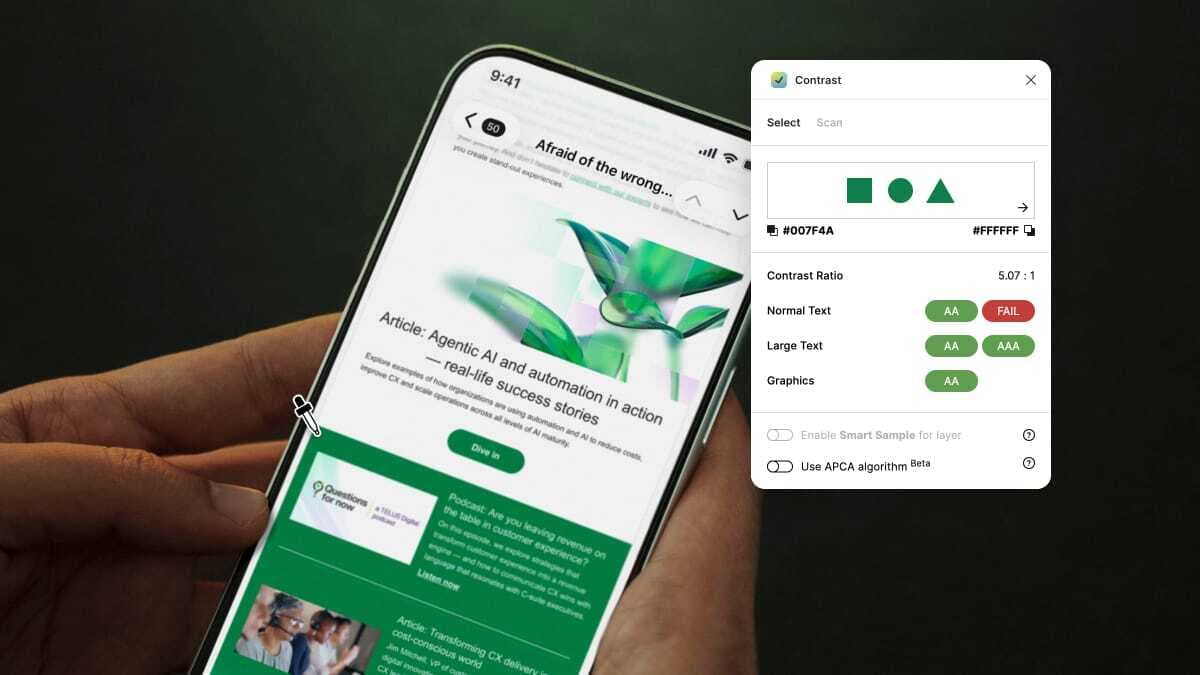
- Implement a high contrast ratio (minimum 4.5:1) and use sans-serif fonts (minimum 14px) for optimal readability.
- Create clear visual hierarchies with consistent spacing and responsive design principles.
- Ensure color isn't the only way information is conveyed, supporting users with color vision deficiencies.
Structure content for assistive technologies
The way you structure email content can make or break the experience for users of assistive technologies. Proper organization isn't just about visual appearance; it's about creating a logical flow that screen readers and other tools can interpret correctly, ensuring all users can navigate your content efficiently.
Best practices:
- Build a clear content hierarchy using proper heading structure (H1, H2, H3).
- Create meaningful navigation with descriptive link text and consistent patterns.
- Implement semantic HTML markup that clearly defines content sections and data tables.
Provide alternative content options
We live in a multimedia-rich world, so ensuring all content is accessible requires thoughtful alternatives for different types of media. The key is not to duplicate content, but rather to provide equivalent experiences for all users, regardless of how they consume content.
Best practices:
- Include descriptive alt text for images that conveys both content and function.
- Provide transcripts and captions for audio/video content.
- Offer plain-text alternatives for complex visualizations and interactive elements.
Ensure technical compatibility
Technical compatibility is the backbone of email accessibility, ensuring your carefully crafted content reaches all users as intended. With the diverse array of email clients, devices and assistive technologies in use today, thorough testing is essential for success.
Best practices:
- Validate your email accessibility across major email clients and screen readers.
- Ensure smooth keyboard navigation and proper code validation.
- Test thoroughly across different devices and platforms to guarantee consistent accessibility.
From vision to value: Roadmapping implementation
Implementing accessible email design doesn’t require a complete overhaul of your existing processes. It’s about refining your workflow through intentional, actionable steps.
Begin by auditing your current email library using industry-standard tools to evaluate existing templates against WCAG standards. This initial assessment allows you to identify critical accessibility gaps and prioritize fixes based on their potential impact. Once these gaps are identified, build accessibility into your brand’s foundation by creating a master suite of templates. By establishing clear guidelines for font sizes, color contrast, heading hierarchies and alt-text requirements, you ensure that every communication is born accessible from the ground up.
Success in this transition ultimately depends on the people and protocols behind the technology. It is essential to ensure everyone involved in the email lifecycle understands core accessibility principles. By providing specific training and making accessibility testing mandatory in your standard QA process, inclusive design becomes a repeatable habit.
At TELUS Digital, email accessibility is a foundational element of the high-converting marketing ecosystems we build for our partners. By integrating WCAG standards into every automated workflow and creative asset, we ensure your brand’s most powerful channel reaches every customer, driving measurable impact through inclusion.