
How do you move from chaos to clarity with CX AI? (feat. Zendesk)
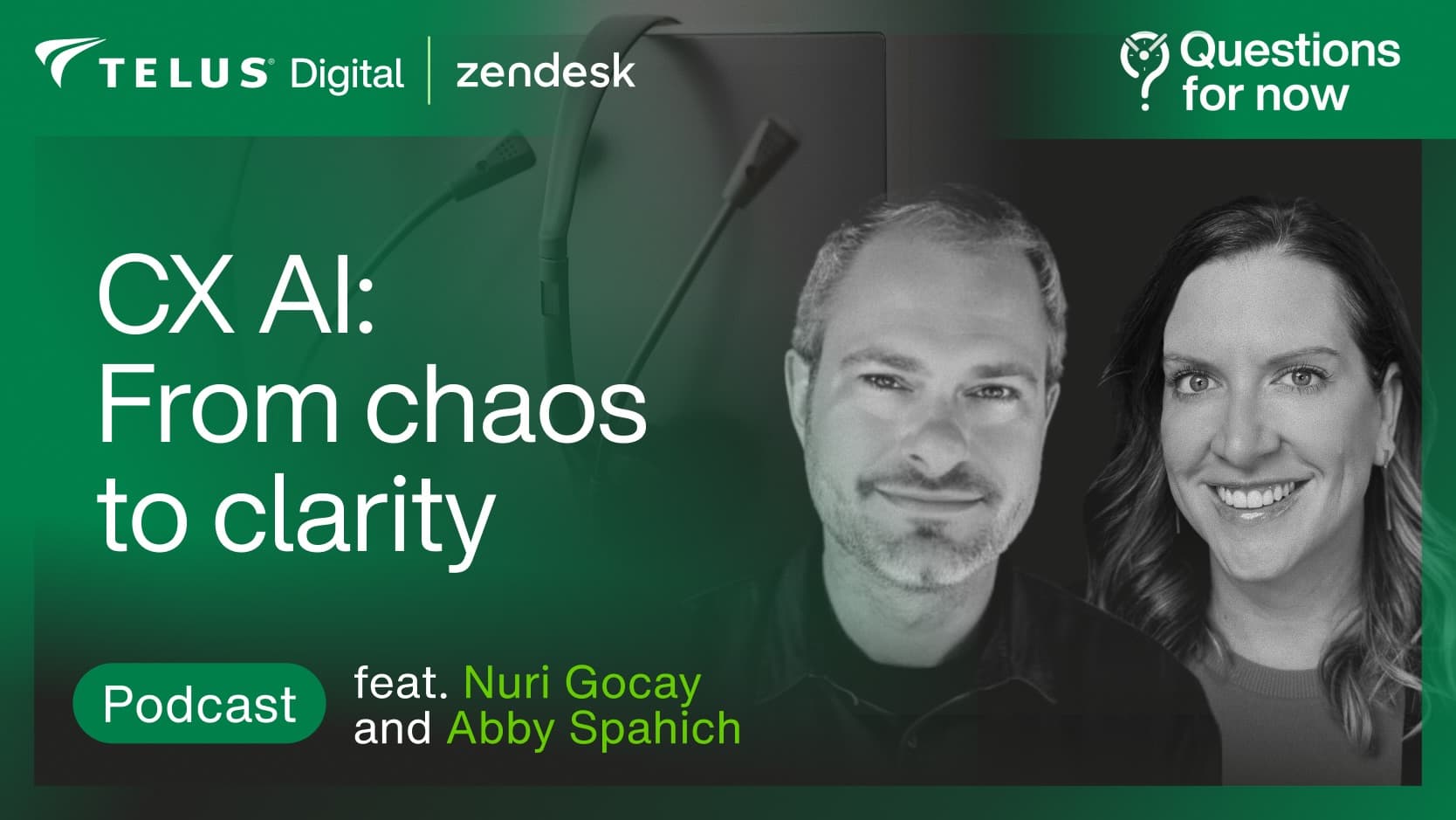
On this episode, we explore AI orchestration in contact centers — and what CX leaders need to know to move from digitized chaos to operational clarity.
Most brands have implemented AI in their customer experience operations to some degree. But when systems are siloed, data is fragmented and workflows are disconnected, AI can magnify problems instead of solving them.
AI orchestration in the contact center changes that by connecting your data, systems and workflows so AI can make real decisions across every channel. This can increase resolution rates, improve agent experience and drive measurable business impact.
Nuri Gocay, director of contact center platform architecture at Zendesk, and Abby Spahich, global vice president for digital CX solutions at TELUS Digital, map the path from operational fragmentation to orchestrated clarity, making the case that true AI orchestration is ultimately about delivering better customer experiences, not just better efficiency metrics. Their perspectives cover readiness, organizational barriers and the first steps toward a truly orchestrated CX operation.
Show notes
Join us at Zendesk Relate 2026 in Denver, Colorado, May 18–20, 2026. TELUS Digital is a platinum sponsor — be sure to stop by our booth to connect with our team in person.
Read Abby Spahich’s latest article, The modern CCaaS strategy: Five steps for turning efficiency into growth.
Follow and listen:



Guests

Director of contact center platform architecture at Zendesk

Global vice president, digital CX solutions at TELUS Digital
Episode topics
- 00:00 - Identifying digitized chaos in the contact center
- 01:25 - The growth of the AI orchestration market
- 02:32 - Transitioning from assistive to agentic AI
- 05:41 - The real cost of siloed data systems
- 08:24 - Operational benefits of orchestrated CX
- 09:48 - Implementing the resolution learning loop
- 10:42 - Building a unified nervous system
- 12:19 - Resolution vs. deflection: defining success
- 17:46 - Overcoming organizational barriers to AI adoption
- 20:49 - The lighthouse strategy for enterprise rollouts
- 23:27 - The TELUS Digital and Zendesk partnership
- 28:02 - Future trends: outcome-based pricing in CX
Transcript
[00:00:00] Robert Zirk: Most brands you know and love have enabled some form of CX AI in their contact center operations. But the ones who are most successful are the ones orchestrating it.
[00:00:11] AI orchestration in the contact center means connecting your data, systems and workflows so AI can make real decisions across every channel and increase resolution rates.
[00:00:24] Without orchestration — when CX AI is built on top of siloed systems, fragmented data and disconnected workflows, it doesn't fix problems so much as it magnifies them, creating digitized chaos.
[00:00:39] Robert Zirk: Today on Questions for now, I'm joined by Nuri Gocay, director of contact center platform architecture at Zendesk, and Abby Spahich, global vice president for digital CX solutions at TELUS Digital. We'll explore what separates the leaders in CX AI from everyone else and what the path to orchestration actually requires as we ask: How do you move from chaos to clarity with CX AI?
[00:01:12] Welcome to Questions for now, a podcast from TELUS Digital where we ask today's big questions in digital customer experience. I'm Robert Zirk.
[00:01:25] Robert Zirk: Organizations are making big investments in AI orchestration. According to Grand View Research, the global AI orchestration market is expected to reach nearly $59 billion by 2033, increasing by a compound annual growth rate of 22.4%.
[00:01:44] Let's build up to the present moment in CX and how we got here.
[00:01:48] Nuri Gocay: We've been on this arc for the last, probably, 25 years around voice technology and automation and contact centers.
[00:01:54] Robert Zirk: That's Nuri Gocay, director of contact center platform architecture at Zendesk. His career spans AWS, Google, Cisco and now Zendesk. Over the course of his career, he's watched contact center technology evolve from on-premise equipment and copper phone lines to internet-based telephony, computer telephony integration and voice automation.
[00:02:17] Nuri Gocay: It's just been like every couple years we've had a step change, but we really haven't been able to deliver on that promise that we've been making to customers about "we're going to provide resolution."
[00:02:27] Robert Zirk: But Nuri sees that changing across the contact center industry as a whole.
[00:02:32] Nuri Gocay: Now, we're at this place in our business where the growth-at-all-costs era is over. The mandate is now efficiency and it's retention and it's trust. We've moved from a world of assistive AI, where AI is helping humans type faster, to agentic AI, where AI systems are capable of true end-to-end resolution, and we're finally able to deliver on that promise to our customers in this space.
[00:02:57] Robert Zirk: And the numbers back that up. Nuri noted that Zendesk processed 15.6 trillion tokens with OpenAI last year and that some of Zendesk's customers are seeing automation rates above 80%.
[00:03:10] But that's only possible when your systems are adequately orchestrated. If they're not, you end up with digitized chaos.
[00:03:19] So what exactly do we mean when we say digitized chaos?
[00:03:24] Think about it this way. Most contact centers have layered new AI tools on top of legacy systems: a CRM here, a knowledge management system there, maybe a predictive analytics tool somewhere else. All of these systems might use AI to some degree, but when you have digitized chaos, none of these systems are talking to each other. The data lives in silos and the workflows don't connect. Nuri described it this way:
[00:03:51] Nuri Gocay: If you've ever been in a contact center before, and I'm sure you have, you've seen it, they've got a legacy on-premise PBX sitting in a basement. You've got a separate silo for email, you've got a disconnected social team and then someone comes in and says, "Yes! I want to put some AI in this and call it all 'digital transformation'."
[00:04:08] Robert Zirk: Often, different stakeholders want different AI tools for different use cases, a big part of the problem is the pressure leaders are under to act fast.
[00:04:19] Gartner reports that 91% of service leaders experience pressure from executive leadership to implement AI.
[00:04:27] When pressure, rather than a cohesive strategy, is the driver, this can create a patchwork of disconnected tools and teams.
[00:04:35] Nuri Gocay: Putting AI on top of silos isn't transformation. And that's what I mean by "digitized chaos". AI can't do the best for your business if it can't see all parts of it, just like the inefficiencies that are caused by having agents in separate pools, you can't blend them together and realize the efficiency of that entire pool.
[00:04:55] But if your voice AI doesn't know that your customer has just emailed you 10 minutes ago about a refund, then all you're doing is deploying robotic annoyances for your customers.
[00:05:06] And what that causes is a problem. It basically prevents doing any kind of proactive customer experience. You've got all the telemetry to know that their app has just crashed, but since your systems don't talk, you just sit there waiting for the phone to ring, so a frustrated customer can yell at you.
[00:05:24] You aren't anticipating the problem and you're just bracing for impact.
[00:05:29] Robert Zirk: In other words, you can't fix a broken customer experience just by buying new tech any more than you can fix the issues caused by a poorly maintained road by buying a nicer car.
[00:05:40] (Sound of a car driving on an audibly bumpy road)
[00:05:41] Robert Zirk: So what does digitized chaos actually cost organizations in measurable terms?
[00:05:47] When organizations operate in siloed systems, fragmented data and disconnected workflows, the costs ripple across multiple dimensions.
[00:05:56] For customers, there's the friction of having to repeat information and disconnected handoffs when moving between channels.
[00:06:03] Nuri Gocay: If your AI isn't properly tapped into your knowledge base or your ticket data and understanding what a good customer experience looks like, understand what it really takes to resolve this type of problem without having that, at Zendesk, we call it the resolution learning loop.
[00:06:21] Basically you're just pulling knowledge articles from someone's help center or for their public website at what percent efficiency, at what percent accuracy?
[00:06:31] Robert Zirk: But there's another cost that's equally important: the impact on the agent experience. When agents are stuck toggling between systems to find the context they need, it can cause frustration on both ends of the line.
[00:06:46] Abby Spahich is global vice president for digital CX solutions at TELUS Digital. She has 20 years of contact center experience from working in contact center operations to consulting on transformations to now leading contact center strategy at TELUS Digital. She shared an anecdote that illustrates the cost of a poor agent experience.
[00:07:07] Abby Spahich: I have a very close friend of mine who just recently got an offer and a job inside of a contact center, was there for a few weeks and reached out to me and was like, "Is this what contact centers are like?"
[00:07:17] And there's part of me that said, "Sometimes they're a little messy and that's why they typically will hire consultants and other organizations to help come and tighten up the ship a little bit." They're a well-educated, very strong employee that organization lost out on after a very short period of time in role. I think that candidate made it just under four weeks there.
[00:07:35] So thinking through how they strengthen that, you're now talking about having to go recruit more people. You're talking about reputational risks on things like Glassdoor or other tools that rate employers. You're looking at that customer experience. If we don't think that with a poor agent experience comes also a poor client experience, we haven't spent enough time on the phones, right? Whether it's that it took 20 minutes for that person to be able to find the tools or the knowledge article that would assist them, but that end experience is really bad.
[00:08:02] And then you have what would be customer attrition or customer churn. All those things added together is a huge opportunity cost.
[00:08:08] Robert Zirk: The costs of digitized chaos might start in one area, but they spiral: higher turnover and lower morale among agents, worse outcomes and reputational damage with customers and missed opportunities to leverage data for upselling and cross-selling.
[00:08:24] But what does the opposite look like?
[00:08:28] When organizations successfully orchestrate data, workflows and intelligence across channels and systems, the operational reality changes completely. Abby described what she sees in well-orchestrated organizations:
[00:08:42] Abby Spahich: I think, operationally, it's just a smooth transaction, not only for the agent as they're processing it, but also for the customer.
[00:08:49] Robert Zirk: And that can translate into improved financial performance. Abby shared an example of how the team helped one client connect their training workflows to their knowledge management systems.
[00:09:00] Abby Spahich: We were helping another organization with some of their training for their agents who are on the phone for a retail sales opportunity, and that outcome, through a more orchestrated experience, was a higher ticket, right? So they're looking at 20% additional ROI on each of those different phone calls from the ticket price or the purchase price actually exceeding what it used to be before the training was better. The performance that you can have in an organization is absolutely stronger when you have a well-orchestrated process and experience.
[00:09:30] Robert Zirk: The snowball effect of orchestration is real. Better agent experience leads to better customer experience, which leads to better retention, which can lead to higher revenue.
[00:09:41] The operational smoothness of orchestration requires your data and knowledge to be connected and intelligent.
[00:09:48] Nuri highlighted that that's where the resolution learning loop comes in — which is the ability for your systems to continuously learn from every interaction and feed that intelligence back into your knowledge base and other systems so AI has the right context to make decisions.
[00:10:04] Nuri Gocay: I think that's where Zendesk has really nailed that. With our knowledge graph, our data is completely optimized and ready to go for AI. Our ticket data runs through our QA where AI is basically looking for things like, " Did the agent resolve the process? What process did the agent use to fix that problem?" and then feeding that back into the knowledge base, right? So it becomes this self-learning, self-healing loop where we're not spending tons of time training AI, but we're actually using real data to get those things.
[00:10:36] Robert Zirk: Nuri used the metaphor of a unified nervous system to describe how these dimensions interconnect.
[00:10:42] Nuri Gocay: When I think of a unified nervous system, I think of no matter where the problem is coming from, it's able to act as a single, continuous conversation. That means not bolting on different tools together and hoping that you get a good outcome. And from a Zendesk contact center perspective, that means taking the world's most flexible, scalable, reliable voice infrastructure, which is Amazon Connect, directly into the world's most intelligent service platform, which is Zendesk.
[00:11:19] So voice is no longer acting as another tool that's being bolted on. It's being treated as a continuous conversation. So when that unified nervous system is working together, regardless of what direction the customer's coming at us from and for what problem, we're going to get the same results.
[00:11:37] Robert Zirk: In other words, it's about having tools that are capable of working as one integrated system that treats voice, email, chat, and social with the same intelligence and capabilities. That's orchestration in the contact center. And at its heart is something both Abby and Nuri emphasized: resolution.
[00:11:59] Resolution is a core theme at Zendesk Relate, a conference happening this May in Denver, that'll bring together more than 2,000 service leaders to explore the future of customer experience in the age of AI. You might assume resolution is synonymous with "first contact resolution", but that's only part of the story. Abby explained the nuance.
[00:12:20] Abby Spahich: Sometimes I think that we may not be measuring that right. You know, "if after three days that person hasn't called back, guess what that was? That was first call resolution." When really they actually called back on the fifth day or whatever the return callback time is.
[00:12:33] Resolution Is the most important thing. When I worked at a bank, I was working the evening shifts and we would have a lot of calls for people who wanted to increase their debit limit when they were, let's say, having fun in Vegas.
[00:12:42] And so people would call us at 11 o'clock at night. And I would remind my employees that, like, "Hey, they're not calling us 'cause they want to be on the phone with us. They would rather be back doing what they were doing with the money that they needed and having fun."
[00:12:55] So it's really about how do you make it to where your customers are able to get the need that they have resolved, number one. And then number two, as quickly as possible, right? Sometimes I think people believe that a longer average handle time could be better and that's not necessarily wrong. I think there's too short and there is too long, right? We want to make it to where the client is getting all of their needs taken care of in the moment and not exceeding the amount of time that it actually took to get it done because that truly is an inconvenience.
[00:13:24] Robert Zirk: And Nuri added an important distinction: the difference between resolution and deflection.
[00:13:30] Nuri Gocay: What's your deflection rates in your IVR? What percentage is your AI deflecting customers? I want to turn deflection into a bad word because deflection is basically making angry customers go away faster.
[00:13:43] Do I know that they've got their problem resolved? No? All I know is that they've hung up in the IVR. I don't know if I've actually fixed their problem. Maybe they switched channels or maybe they hop on social media and start spreading bad news about our company. Deflection and resolution could almost be viewed as the same thing, but resolution is actually fixing the customer's problem.
[00:14:04] The challenge is: how do we do resolution at scale and how do we do it across a variety of workflows and verticals? And I think that's where Zendesk, once again, is really well poised to be able to give our AI solutions the hands it needs to do the work just as a regular human would.
[00:14:22] Robert Zirk: There's the quantitative side: Did the customer call back? And the qualitative side: Did they feel heard and helped?
[00:14:31] Abby explained why it's important to consider a balance between the two when creating a rubric for resolution.
[00:14:37] Abby Spahich: So there's this subjective view and an objective view. And looking at how you go at these customer experiences, you're gonna find times where, you know, was a one minute hold time a good hold time?
[00:14:49] Robert Zirk: For example, when calling customer support for a clothing brand to ask about a return or an exchange, most people would be happy with a one minute ASA or Average Speed to Answer.
[00:14:59] Abby Spahich: But, on the other hand, if you're calling, let's say 9-1-1, where they have call centers and operators there to help us. If you have to wait a minute, that might not be the best case scenario. You wanna have an immediate pickup. And so, if you think about all the scenarios that you could have when you're actually calling into a contact center and the different variables for the types of contact centers that actually exist, you are gonna find some of that is stratified based on either the type of organization, the customer that they're supporting and also the tiered level of service that they're providing.
[00:15:29] Robert Zirk: Orchestration isn't just about building the right system for your context, but ensuring context can be surfaced to make the customer journey as seamless as possible.
[00:15:38] Nuri challenges you to imagine a scenario that'll illustrate what I mean. Imagine you have a customer, they're at the checkout page on your e-commerce site.
[00:15:48] Their payment fails and, three minutes later, they call support. Now, ask yourself:
[00:15:54] Nuri Gocay: "Does my AI know why they're calling before it says hello?" If not, you have digitized chaos.
[00:16:01] Robert Zirk: So when we talk about the difference between chaos and clarity, we're talking about the difference between an agent asking, "How can I help you today?" and an orchestrated CX AI system enabling an agent to pick up and say something along the lines of, "I see your payment didn't go through on your checkout. Let me help you get that sorted."
[00:16:21] Nuri explained why this matters so much.
[00:16:24] Nuri Gocay: We sit on all of this massive telemetry as companies. We know our customer's purchases, their clicks, their failed payments, their app downloads. We know exactly where their package is or that it has been delayed or that their flight just got canceled.
[00:16:44] Asking a customer why they are calling when we already have that data is an insult to our data. So what I would ask customer experience leaders to do is to stop relying on those old paradigms, those old call center playbooks that are now 30 and 40 years old, and envision a world where data is making those conversations easier, both as context for AI, but also context for the human agents.
[00:17:16] Robert Zirk: Nuri mentioned that 20 years ago, connecting your telemetry to your routing would've been nearly impossible. Data lived in silos, and it was difficult to integrate systems.
[00:17:26] But now, with new solutions, large language models and AI, the technical barriers have broken down. The barrier that remains is the organizational vision — specifically, the willingness to redesign how you approach customer interactions. Abby identified this barrier at two levels, starting with governance:
[00:17:47] Abby Spahich: Sometimes governance groups are too large. I think that, in reality, you really want to make sure that you've got all of the right voices at the table. But I also think, at the same time, when you do that, you can slow down the progress that you need to have within the organization.
[00:18:00] Other things that I've seen are leaders who are wanting to do new and cool things, but not really willing to let go of some of the fundamental things that they've known in their history of their leadership experience. You can see that sometimes with quality management and some of the automated tools that are out today. Someone may feel like they wanna have a person go and actually listen to each of those calls individually, whereas you can really get a better kind of flavor for what's going on in your contact center if you do have something that's rapidly moving through how those qualities are actually having an outcome.
[00:18:30] Robert Zirk: Abby explained how misalignment between operations and technology can show up in the actual systems and workflows.
[00:18:37] Abby Spahich: You'll have tech who says, "Hey, X, Y, and Z meets your use cases better." But you have operators who are like "Well, I've used this system more frequently and I'm more comfortable with it and this is the one I want to use for the organization."
[00:18:47] And so when you see that kind of gap between the two, what I think can be sides at times, it's really important to make sure that you're helping to remove that communication barrier or the barrier and actually look at what those use cases are. It goes back to people who are used to something sometimes have a hard time moving their business forward in a way that's really adoptive to what are the new technologies that are helping their organizations move forward.
[00:19:09] Robert Zirk: So at times governance structures can slow progress, as can resistance to change at the leadership level and organizational misalignment.
[00:19:19] Robert Zirk: If you're listening to this thinking, "Okay, we need to orchestrate our CX AI, but what are we getting into and how long is this going to take?", let's talk about the actual journey from chaos to clarity.
[00:19:31] There's no single timeline. It depends on where you're starting from and how amenable your organization is to change. But Abby provided some examples:
[00:19:41] Abby Spahich: If they're just looking to implement a CCaaS technology or a contact center as a service technology, it could not take that long at all, like, we've got some that are going through the process in a month and a half. These are ones that are mid-range on their complexity.
[00:19:54] You've got some that are gonna be enterprise-wide and they've gotta get their 20 business units in line to go through the process. That's gonna take a little bit longer to modernize and kind of walk them through that journey.
[00:20:03] But, that being said, I think the exact answer is it depends on how far advanced they are in their modernization efforts and then also how willing they are to take on change.
[00:20:13] Change management is a very significant portion of it and getting your agents prepped for whatever that modernization is. So it depends on the appetite of the company to be willing and able to move quickly.
[00:20:23] Robert Zirk: As we've just heard, the real variable is how willing your organization is to actually let go of the old ways and embrace new ones. Abby's point about pacing is critical. To add to that, Nuri shared another consideration: not every organization needs to commit to a full enterprise transformation right away. Sometimes the smartest approach is to start small and experiment first.
[00:20:49] Nuri Gocay: The way I like to present these things to customers is around an architecture audit and a lighthouse build.
[00:20:56] So what I'll say to customer experience leaders is: "What is that one business unit you have that maybe bleeds the most margin or has the worst CSAT scores or the most employee turnover? Let's deploy our unified stack there, our resolution learning loop, our vision for customer experience and let's attack that. Let's figure out those problems and let's see what actually happens."
[00:21:22] And once people see what that one department is doing, now operating with a better predictive CX, they won't just be asking for a global rollout, they're going to be demanding it. So it's always one of those: start small, start focused, measure often, come into it with an idea of those metrics that you want to improve, and then let those be your north star as you track toward it.
[00:21:45] And then you've basically built a lighthouse for the rest of your organization and they're going to demand to be a part of it.
[00:21:50] Robert Zirk: The key is understanding your organization's readiness, your complexity and your risk tolerance. Then, choosing an approach that makes sense for your situation.
[00:22:00] I asked Abby: for CX leaders who are ready to start the journey, what's the first step?
[00:22:05] Abby Spahich: Have discovery ready to go. And when I say discovery, it means that's the first stage that every organization's gonna be in when they're going through modernization.
[00:22:13] What technologies do they currently use today? What do they need to be using tomorrow? What are their main goals for going through the modernization? And having those things solidified in the organization before you're coming to the table, it helps to decrease the amount of time that it takes to scope out the work because it's more well-defined.
[00:22:30] So I think as you're looking at your contact center, it's really identifying your pain points, understanding where you wanna go and what it's gonna take to get there. And then making sure that you're choosing a strong partner to help you through that process.
[00:22:42] Robert Zirk: Deloitte reports that 25% of organizations identify inadequate infrastructure and data as obstacles to achieving AI ROI.
[00:22:51] So the discovery phase is where the real work begins. You'll identify what you're currently using, explore where orchestration could have the biggest impact and define what success looks like. A partner like TELUS Digital will guide you through that process and help you spot opportunities you might have missed on your own.
[00:23:10] Orchestrating your CX AI may seem daunting, but you don't have to tackle it alone. Partners who understand both the technology and operations can accelerate your progress. Nuri explained how the partnership between TELUS Digital and Zendesk can help organizations orchestrate.
[00:23:28] Nuri Gocay: Zendesk provides the engine — world class customer experience software — but organizations need, for lack of a better term, a general contractor to wire up the house. And that's where I see TELUS Digital really excelling in the space, and that's in the service design, building those integration pipes from data lakes like Snowflakes or Databricks into somewhere where it Zendesk can access it. Building the APIs that give the AI hands. They are the architects of these solutions and TELUS Digital has such a mature practice across digital and mobile and app space and also customer experience.
[00:24:09] So they're really leaders in understanding the space and how to get the most out of these great tools, preventing customers from taking something like their 20-year-old customer experience and moving it to a new shiny object. It's actually taking the thought and time to redesign those to get the most benefit out of them.
[00:24:28] Robert Zirk: Contact center orchestration at scale requires deep expertise and proven experience. Abby shared how TELUS Digital helps organizations get there.
[00:24:38] Abby Spahich: One of the things that I think is most important about orchestrating, especially when it comes to the technologies that are available in the market today, is working with an organization like TELUS Digital that has really strong and committed relationships with partners.
[00:24:51] As an example, with Zendesk, we are a premier partner. We're AI exempt. We have all of these capabilities with them and we also have an extremely strong practice that helps to deliver Zendesk to the best of its ability and to the best of its orchestration, which is one of the best on the market.
[00:25:07] That being said, there are multiple facets of what it is going to take to get you there. And one of the things that I think TELUS Digital brings to the table more than almost any other consulting firm is that not only do we have this immense contact center experience — we have 85,000 people who are in our contact center practice.
[00:25:26] And then lastly, we also have proven success. We're working with about 600 major brands and, in those, you have all of these different high touch, mid touch, et cetera types of clients. And so we have this vetted experience that we bring to the table that — I just don't know of a single other consulting firm on the market that can do it the way that we do it.
[00:25:45] Robert Zirk: With the onset of agentic AI, large action models and new platforms, the pace of change in CX AI is relentless and it can be difficult to know where to begin.
[00:25:56] Abby advises leaders to think of the journey in stages.
[00:26:00] Abby Spahich: It's really like thinking about it in chunks, right? You don't have to do everything tomorrow. And pacing yourself. It's just like when you're running a marathon, you're gonna get to the end of it. It just depends on if you're gonna sprint this mile or if you're gonna run it or if you're gonna walk it.
[00:26:12] Robert Zirk: You just need to pace yourself. The most important thing is to stay connected with your agents, your customers and your own organization, because if you move too fast without bringing people with you, you'll overwhelm them.
[00:26:27] We've talked about the chaos, the barriers and the journey to clarity, but what's the real opportunity here? For contact centers that actually crack orchestration, that build that unified nervous system, what becomes possible? Nuri looked at this from the perspective of predictive customer experience.
[00:26:45] Nuri Gocay: I really feel strongly about this. With the ubiquity of large language models and cheaper inference, things like "our data is hard to get to" is no longer a valid excuse. It's overcoming that lack of vision. The opportunity is answering the customer's question before they even have to ask it.
[00:27:04] And if you take that data thread on, I think a contact center is probably the most rich source of customer experience data that we have as businesses. Literally, customers are telling you every single thing that they like about your products and which ones they don't, and which policies cause the most friction, right? Like, we're in a place where we can actually analyze this data at scale. And for us to not be using those things is just such a waste.
[00:27:36] The biggest opportunity I see is just looking at all the data we collect and making some sense out of it. It will help improve our customer experience operation so much. It'll help us lower our cost per contact. It'll help us improve our average handle time, that will help us improve our customer satisfaction. Basically, all the tools we need, we already have. We just need to apply them correctly.
[00:27:57] Robert Zirk: And Abby added perspective on how the industry itself is shifting toward resolution.
[00:28:02] Abby Spahich: We're looking at more what would be resolution-based outcome pricing or outcome-based pricing or resolution-based pricing versus it being per-head, which we have seen in contact centers for quite a while with licensing basically per person. So resolution is not only changing the way that we are doing business today, but it also changes that customer journey and that experience itself.
[00:28:23] Robert Zirk: So the future will see a fundamental shift in how the industry operates: from deflection to resolution, from reactive to predictive, from per-head pricing to outcome-based pricing and from siloed data to unified intelligence.
[00:28:39] It's clear that organizations who orchestrate their CX AI now will have a massive competitive advantage tomorrow and beyond.
[00:28:47] As we wrap up, ask yourself this big question: "Is our customer experience orchestrated or is it in digitized chaos?"
[00:28:57] Start by looking at your data. Is it siloed? If so, start with discovery. Map your current state, understand your pain points and identify where you're losing money and customers. Then, partner with someone like TELUS Digital who understands both the technology and the operations.
[00:29:18] According to Gartner, 77% of infrastructure and operations leaders who have achieved at least one successful AI use case credit that success to workflow integration and executive buy-in.
[00:29:31] As Abby explained, orchestration isn't about the platform you use, but about how you bring it all together.
[00:29:38] Abby Spahich: There are a lot of variables when it comes to modernizing your contact center and the biggest thing is to know what your tolerance is, what your staff's tolerance is, and what your customers' tolerance is to that change and the experience that they're gonna be going through.
[00:29:52] And there are lots of things you can do to not only help readiness for yourself and others but that change management path and route is an incredibly important one to keep an eye on. So I'd say that, and then I'd also, I'd love to, ask a question here to just say, what challenges are people facing in their contact centers that are watching this? And then offer some assistance.
[00:30:15] Robert Zirk: Both Abby and Nuri brought the conversation back to Zendesk Relate, which takes place this May 18th through 20th in Denver, Colorado. TELUS Digital will be there as a platinum sponsor.
[00:30:28] I asked them what conversations they're most excited about at the event. Abby shared what she's watching for.
[00:30:35] Abby Spahich: I think that Zendesk has some really cool stuff that's happening. And as we're thinking through with Zendesk, what do we want not only the ambiance to be for people, like we want it to be a place where people can come and ask questions and be there for thought leadership within CCaaS and where are things going?
[00:30:51] What I think is gonna be happening during Relate is I bet there's gonna be a lot of questions related to agentic AI — we're hearing that everywhere. Large action models. And then also, with Forethought being a recent Zendesk acquisition, I'm actually interested to see if there's a lot of people interested in some of their browser-based agentic AI tools that they have and how Zendesk and TELUS Digital, with the partnership that we have, we can definitely help to make sure that those are implemented in a way that makes the most sense for the organization.
[00:31:17] Robert Zirk: And Nuri shared what he's most excited about.
[00:31:20] Nuri Gocay: It's gonna be a lot of surprises over a bunch of product lines, especially Zendesk for Contact Center. I'm not gonna spill any beans early, but it's gonna be pretty fundamental and foundational for us at Relate.
[00:31:31] I will be giving a presentation on Monday that our customers or people attending Relate can go to. I'll be providing a deep dive of Zendesk Contact Center, so before it actually gets announced, they'll be able to touch, play and actually dial in and see what that day in the life of an agent's like.
[00:31:47] So I'm really excited to be giving a smaller group of people really in depth hands-on, on what this is going to look like. So if you're interested and a Zendesk customer, let your account executives know and we'll get you into that session that I'll be providing on Monday. It's gonna be an amazing week for customer experience.
[00:32:04] Robert Zirk: So if you're a CX leader and you're serious about orchestration, you don't want to miss Zendesk Relate. You'll get to see the future of the platform, connect with other leaders who are on this journey and test drive the tools that are going to define customer experience in 2026 and beyond. For more information about Zendesk Relate and to connect with Abby and the team at TELUS Digital, you'll find links in the show notes.
[00:32:35] Thank you so much to Abby Spahich and Nuri Gocay for joining me and sharing their insights today. And thank you for listening to Questions for now, a TELUS Digital podcast.
[00:32:46] If you enjoyed today's conversations, subscribe to Questions for now on your podcast player of choice to get the newest episodes as soon as they're released.
[00:32:55] I'm Robert Zirk, and until next time, that's all... for now.
Follow and listen:
Frequently asked questions
AI orchestration in CX means connecting your data, systems and workflows so AI can make real decisions across every channel, resolving customer issues end-to-end. Without it, AI tools layered onto siloed contact center systems magnify the underlying fragmentation, adding noise where you need clarity. TELUS Digital's CCaaS and CRM solutions are designed to help organizations move from fragmented AI deployments to fully orchestrated CX operations that can drive measurable resolution rate improvements.
Deflection means a customer stopped calling — but you have no idea if their problem was actually solved. Resolution means you know the issue was fixed. The distinction matters because when deflection is the primary success metric, a broken customer experience can go undetected until it shows up in churn rates. The most forward-thinking contact center leaders are redesigning their performance frameworks around resolution as the primary measure of CX AI effectiveness.
TELUS Digital brings contact center operations depth to Zendesk's CCaaS and CRM platform — connecting customer data, intelligent routing, workforce optimization and AI insights into a coordinated CX operation. The advisory, ROI-focused approach TELUS Digital takes to implementation means organizations get workflows built for resolution, not just deployment. For brands moving away from fragmented AI and toward orchestration, that combination closes the gap between platform capability and measurable CX outcomes.
The costs ripple outward in every direction: customers repeat themselves across channels, agents toggle between disconnected systems and turnover spikes. Digitized chaos can ultimately lead to increased recruiting costs, reputational damage, customer churn and missed up-sell and cross-sell opportunities.
Layering AI on siloed systems amplifies these problems rather than solving them. TELUS Digital's integrated CCaaS and CRM expertise and solutions are specifically designed to help organizations quantify and eliminate these hidden costs before they compound.
Share


Explore recent episodes

Suggest a guest or topic
Get in touch with the Questions for now team to pitch a worthy guest or a topic you’d like to hear more about.
Email the show
