20% more cross-sells in 90 days: The power of forward-deployed engineering (FDE) in contact centers

Vice President, Head of Go-to-Market, Data & AI Practice Lead, TELUS Digital
VP, Engineering, CX AI, TELUS Digital

Director, Solution Architecture, TELUS Digital

Key takeaways
- Contact center AI most often fails not because of the technology, but because of how it’s deployed: Engineers build tools without observing the agents who have to use them.
- Forward-deployed engineering (FDE) embeds engineers directly within contact center teams, treating adoption as a core KPI rather than a byproduct of implementation.
- Across client deployments spanning multiple queue types, results have included 20%+ cross-sell lift, 15%+ AHT reduction and 5%+ FCR improvement, all within the first quarter following launch.
- FDE Squads combine three roles — CX architect, data engineer and AI engineer — working in two-week sprint cycles to observe, build and iterate within live agent workflows.
- TELUS Digital’s operator scale (80,000+ team members in daily customer operations), product design discipline and proprietary Fuel iX™ platform differentiate its FDE model from consulting-based programs.
The last-mile problem in contact center AI — failing to turn a promising pilot into a trusted, widely adopted solution — hits peak frustration for CX and operations leaders. Engineers take requests from operations, use the requirements to develop new tools, then toss them over the fence to agents, often without ever actually observing agents at work. Tool adoption is low, impact is minimal and operations is stuck with the same problems it set out to solve, only now with more bloat.
The lesson: Enterprises need engineers who don’t just build for the contact center, but live within it. That approach, known as forward-deployed engineering (FDE), looks like this.
An engineer sits on the queue beside agents, watching where they abandon a tool mid-call, hearing why the recommended cross-sell offer doesn’t fit the conversation they’re actually in. They flag the friction, adjust the prompt and test the change within days — not at the next quarterly release. When an agent stops ignoring the tool, that’s the signal it’s earned its place.
Using an embedded FDE model, we deliver not just tools, but measurable business outcomes. Tracked across multiple client environments and queue types, FDE has delivered measurable results as quickly as the first quarter following launch:
- 20%+ increase in converting targeted cross-sell offers
- 15%+ decrease in average handle time (AHT)
- 5%+ increase in first contact resolution (FCR)
Here’s how the FDE model works, from the squads who implement it to the ROI it delivers.
How forward-deployed engineering works
The FDE model represents a deliberate shift away from the traditional systems integrator (SI) approach. While the SI model is often transactional — incentivized by hours and delivery of a fixed scope — the FDE model is outcome-driven.
Traditional SI approach (deliverable-driven) | FDE approach (outcome-driven) |
|---|---|
Transactional: Fixed scope, hands-off and exit. Incentivized by hours, not long-term outcomes. | Continuous product mindset: Owns adoption, fine-tuning and long-term success. Incentivized by measurable CX improvement. |
Remote: Lacks direct, daily contact with agents. Product feedback is slow and filtered. | Embedded CX expertise: FDE gathers high-fidelity, real-time data by working shoulder-to-shoulder with the agents. |
Integration: Implementing the core integration layer. | Focused on AI solutions: Optimizes AI models for company-specific intents, policy, tone and data. |
The engine: FDE Squads
If forward-deployed engineering is the strategy, TELUS Digital’s FDE Squads are the operational units that make it real. FDE Squads are embedded directly within contact center teams to observe opportunities, rapidly deploy solutions and deliver results in two-week cycles.
By designing and testing AI tools within actual workflows, these squads ensure that the output is trusted and usable. Adoption is treated as a core KPI, not a byproduct. To achieve this, each FDE Squad requires a unique blend of product, technical and business expertise:
- CX architect: Part strategist and part ethnographer, the CX architect connects user needs with AI capabilities. They map workflows and own the long-term roadmap and outcomes.
- Data engineer: As an expert in CCaaS APIs and data pipelines, the data engineer ensures the AI has a reliable, validated foundation.
- AI engineer: Focused on large language model (LLM) orchestration and real-time integration, the AI engineer builds the production-grade code that ensures tools are both functional and intuitive for agents.
The FDE-powered innovation flywheel
Most enterprise AI projects fail, according to MIT, because of the learning gap (i.e., tools remain static instead of adapting to user needs and workflow realities). The FDE Squad ensures success by creating a continuous innovation flywheel, powered by high-fidelity user stories that flow from the agents to the core product team:
- Deeper insights: The FDE Squad translates raw agent pain points and customer interactions into precise, technical needs.
- Better product: Tools and features (e.g., Agent Assist, Agent Trainer, Agent Quality Insights) are built and selected to solve real problems.
- Faster time to value (TTV): Squads ensure last-mile integration, prompt engineering and on-site training, guaranteeing rapid, successful adoption by the frontline.
- Adoption acceleration loop: Continuous exposure, rapid iteration and real-time feedback create a compounding effect. Agents see immediate value, increasing trust and usage, which in turn generates better data and further improves AI performance.
- Agentic evolution: As adoption matures and insights compound, the squad identifies high-confidence, repeatable patterns suitable for autonomous agents, shifting from assistive AI to agentic resolution.
This innovation flywheel overcomes the last-mile problem of enterprise AI — building solutions that don’t get adopted. In the FDE model, adoption is prioritized as a core KPI, not a byproduct. The FDE Squad designs, tests and refines AI tools in real workflows, ensuring outputs are trusted, usable and aligned with how agents actually operate.
Implementing FDE: From decomposition to scale
FDE fits directly within existing contact center ecosystems — Genesys, Salesforce, Zendesk and others — and accelerates delivery by bringing purpose-built tools like Fuel iX™, TELUS Digital’s enterprise GenAI platform, where they add the most value.
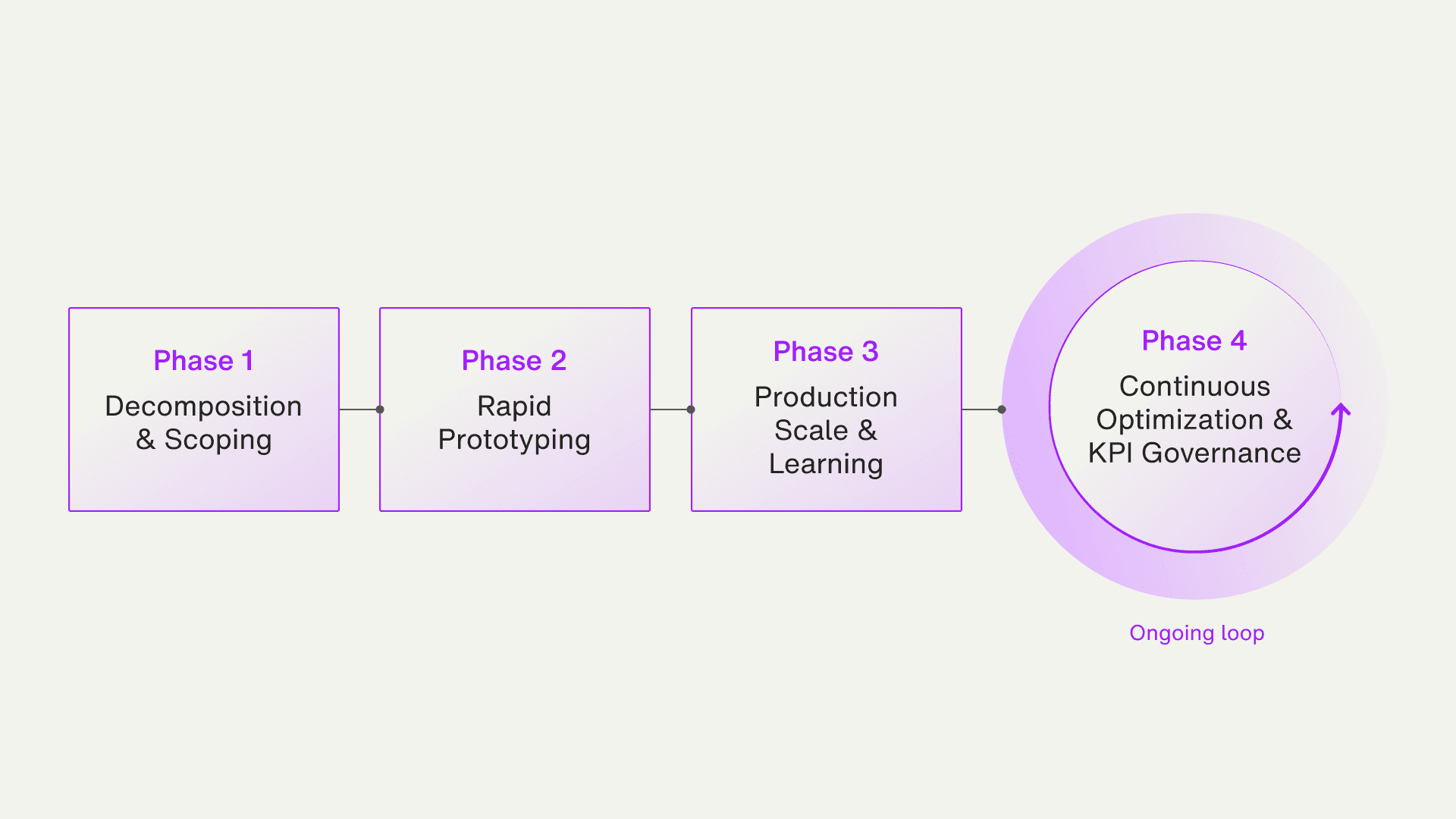
The implementation process follows a rapid, agile methodology designed to move from nebulous goals to technical reality:
- Decomposition and scoping: The FDE Squad analyzes the end-to-end customer journey for areas of impact, examines current CX metrics (e.g., AHT, FCR, CSAT) to diagnose high-impact use cases and create a defined, technical proof of concept (PoC).
- Rapid prototyping: Working side-by-side with agents, the FDE Squad deploys a minimum viable solution (MVS) of an AI tool, iterating daily based on live feedback.
- Production scale and learning: Once an MVS is rigorously tested for security and performance, it is rolled out at scale, during which the FDE Squad continuously gathers learnings.
- Continuous optimization and KPI governance: The FDE Squad closely monitors and optimizes the production solution, ensuring long-term sustainability and reuse across the enterprise.
On the tools and technology side, this implementation approach emphasizes:
- Packaged solution optimization: FDE Squads are directly responsible for integrating, customizing and fine-tuning packaged AI solutions to customers’ specific domain language and policy sets.
- Proprietary innovation: FDE Squads work within clients’ enterprise AI stack to deploy bespoke solutions where off-the-shelf tools fail to meet unique company demands.
- Integration layer: Production-grade code and robust data pipelines ensure reliable connectivity between AI models and backend systems.
- Enterprise architecture and governance: Solutions align with target-state architecture, approved integration patterns, data governance, security and responsible AI frameworks.
Ultimately, implementation of FDE happens not just by shoulder-to-shoulder collaboration between FDE Squads and agents, but also through partnership with client enterprise architecture teams, enabling scale, reuse and long-term sustainability.
Measuring the ROI of FDE: The shift from cost-per-call to value-per-interaction
To prove the value of embedded engineering, we align measurement directly to operational goals, as outlined in the table below.
ROI pillar | Key metrics to track | Business value and impact |
|---|---|---|
Revenue growth | Direct sales (upsell/cross-sell and new revenue) Retention and revenue preservation (saves or churn reduction) Indirect growth (repeat purchases and referrals) | By shifting from a “cost-per-contact” mindset to a “value-per-interaction” model, enterprises can quantify contribution to the bottom line. |
Agent efficiency (hard ROI) | Reduction in average handle time (AHT) or first contact resolution (FCR) for AI-assisted agents Reduction in training time for new agents | Direct labor cost savings Increased agent capacity Faster time to proficiency |
Customer experience (soft ROI) | Increase in CSAT/NPS scores from AI-assisted interactions | Higher customer loyalty and lifetime value Reduced operational costs from churn |
Quality and compliance | Increase in quality assurance (QA) coverage (e.g., from 5% to 100%) Reduction in compliance errors | Reduced regulatory risk Higher consistency in service delivery Lower cost of manual QA |
Solution performance and reliability | Ongoing improvement of recommendation accuracy/helpfulness Increase in acceptance rate Reduction in hallucination or policy-violation rate Improvement in latency/uptime | Higher trust and sustained adoption Early detection of regressions and drift Measurable interaction backlog that improves ROI over time |
What makes TELUS Digital’s FDE model different
Most FDE programs are staffed by consultants and engineers who study contact centers. TELUS Digital knows contact centers inside and out.
With over 80,000 team members serving customers daily from 70+ delivery centers across more than 35 countries, TELUS Digital is both an operator and a builder of AI-powered CX tools. When an FDE Squad fine-tunes Agent Assist or Quality Insights for a client, they are tuning a capability TELUS Digital also deploys internally. The feedback is not sourced from case studies, but directly from the frontline.
That operational grounding changes what the squads prioritize. They have observed adoption resistance from both sides — as the team deploying the tool and as the team whose agents have to use it. They know the difference between a tool that passes QA and one that agents will reach for under pressure.
The digital product background adds a second layer. TELUS Digital’s FDE Squads bring the design-led discipline of a product agency — built on the principle that functional is not the same as usable, and that tools agents don’t trust won’t move metrics regardless of technical quality. Adoption is a design constraint from the start, not a rollout problem addressed after the build.
This combination of operator scale, operator empathy and product design rigor is the foundation the FDE model is built on.
Getting started with FDE
The last-mile problem in contact center AI doesn’t resolve itself with better technology. It resolves when someone stays to make the tool work in the environment where it’s actually deployed. If your contact center AI program is stalling between proof of concept and frontline adoption, contact us to explore what FDE looks like for your operation.
Derek Brameyer
VP, Engineering, CX AI, TELUS Digital
Derek leads AI-native engineering transformation at TELUS Digital, after a career scaling global engineering teams across digital agency consulting and product engineering. He joined WillowTree in 2011 and spent over a decade there, at one point building its Vancouver office from six people to more than thirty in under two years, before the company became part of TELUS Digital. Outside of work, he's keeping up with two young kids and slowly working through a very large LEGO collection.
Derek leads AI-native engineering transformation at TELUS Digital, after a career scaling global engineering teams across digital agency consulting and product engineering. He joined WillowTree in 2011 and spent over a decade there, at one point building its Vancouver office from six people to more than thirty in under two years, before the company became part of TELUS Digital. Outside of work, he's keeping up with two young kids and slowly working through a very large LEGO collection.