Three things CX leaders should do right now for AI transformation

Key takeaways
- TELUS Digital President Tobias Dengel names three things CX leaders should be doing right now: treat AI adoption as a linear path, optimize your data for AI and rebuild your contact center toolsets to support your people.
- Gartner found that 38% of AI leaders cite poor data quality or limited data availability as a direct cause of AI project failure, underscoring why data has to be an active priority, not an afterthought to automation.
- Dengel notes that most contact center toolsets haven’t been modernized. Rebuilding your stack is about giving your people better tools to meet today’s customer expectations.
Ask CX leaders if they're using AI in their contact centers and they’ll give a resounding, enthusiastic yes.
Ask if they're confident in what they’ve deployed and the tone will change. In a 2026 survey of C-suite leaders, a staggering 74% of executives admit they have projected more confidence in their organization’s AI strategy than they actually felt.
Though AI has been dominating CX discourse for years now, certainty has been hard to come by. What’s possible keeps shifting with the pace of innovation and throughout it has not been easy to separate what others are really doing, and to what effect, from the hyperbole.
Move too fast and your AI could lead to some real service delivery mishaps that damage customer sentiment. Move too slow and your competitors could forge ahead while you’re waiting for the perfect setup or use case, all while pressure from other members of the leadership builds.
Then there’s the stakes riding on AI. In a survey of 5,811 consumers and 1,560 leaders, Genesys found that 92% of consumers expect every organization to match the best experience they've ever had, anywhere. With AI increasingly playing a role in customer experience delivery, how well you deploy it has become part of the experience customers are measuring. No one will dismiss a bad experience because it was handled by AI. They'll just remember it was bad.
TELUS Digital President Tobias Dengel often speaks with CX leaders who are caught between moving too fast and moving too slow, with real stakes riding on getting it right either way. His answer isn’t hypothetical, or a vague five-year roadmap, but rather three practical things CX leaders should do right now for AI transformation.
- Treat AI adoption as a linear path, not a leap: Let AI take on more as it earns it through performance, and keep your people on the complex work throughout.
- Take a data-first approach: Your current data, scattered across systems and full of the institutional knowledge only your best agents carry, has to be structured and optimized before AI can put it to real use.
- Rebuild your contact center toolsets: Most were built for a different era of customer service, long before AI, and they're not doing your frontline team members any favors today.
This article expands on each of these three priorities, offering guidance on how to run an AI-powered CX operation you can stand behind.
1. AI adoption in customer experience should be a linear path, not a leap
The instinct, especially with CEOs and CFOs pushing for returns while competitors move, is to go big. Deploy AI across the contact center in one push, chase full automation, treat it like a switch you flip.
Dengel's first priority is a direct correction to that instinct: AI adoption should be a path with a clear progression, not a leap.
You want to think about where your customer experience is today and how you can incrementally use AI to assist your customers and agents, so that resolutions come with less effort and more clarity. Over time, you observe patterns in your CX operation, which give you an indication of where AI can do more and even resolve certain types of customer contacts autonomously. Overall, the end state is human-led, AI-powered CX that brings out the best in technology and human ingenuity.
How to sort customer contacts between AI and people
"Use AI for the basic pieces," Dengel says. "Use your humans for the complex pieces."
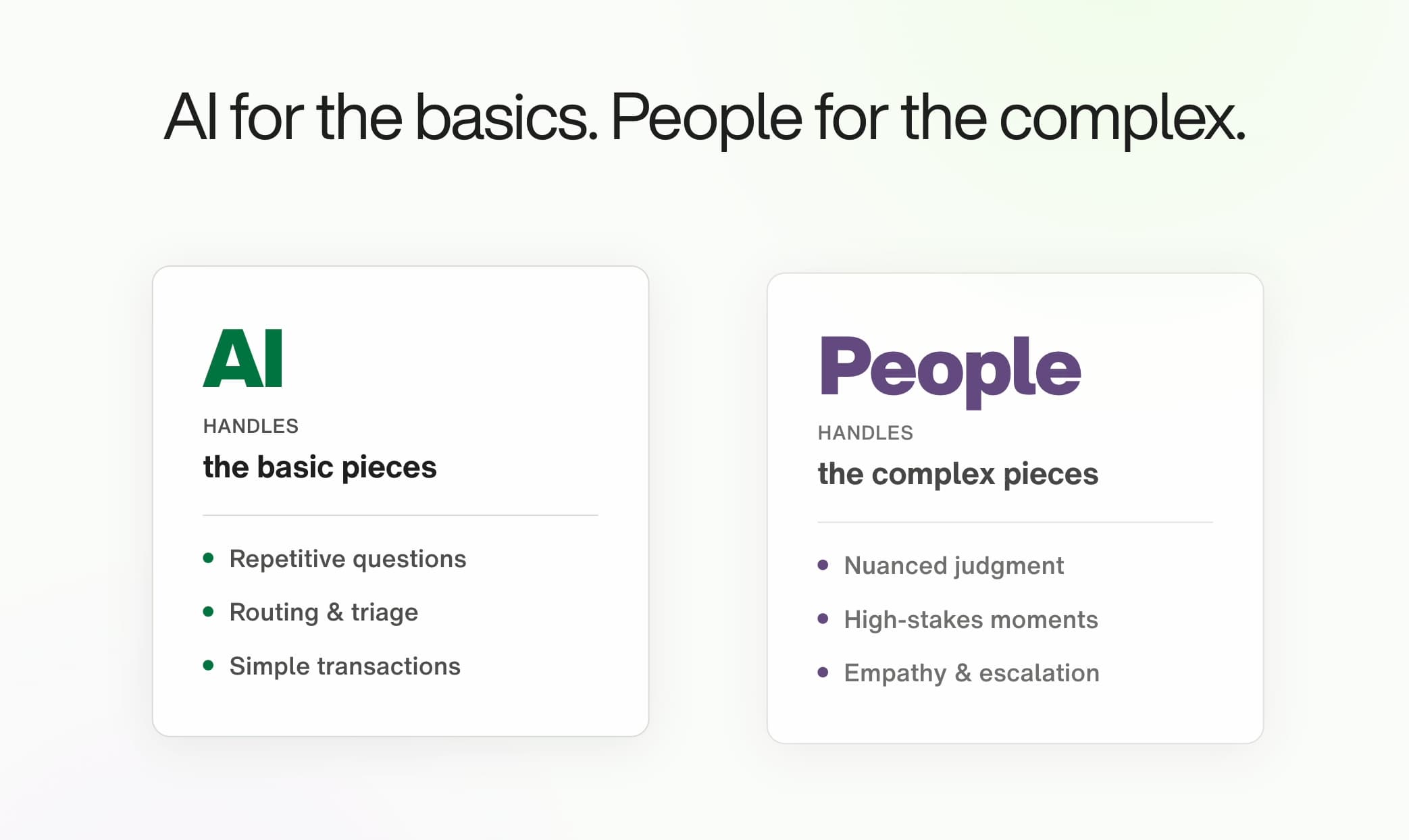
As a CX leader, you’ll know all about the basic, routine inquiries specific to your business. A customer asking for a shipping update on their order. A billing question with the answer already sitting in your help center. A password reset. A request to bundle multiple services. There are innumerable high-volume, well-defined use cases where a customer is looking for a quick, complete resolution, which can be reliably delivered by AI.
The complex work is different. These are the moments where the stakes are high, the emotions are charged and the ambiguity is complex. In these situations, getting the customer to a satisfactory outcome requires a skilled human agent who can read tone, weigh context and make a judgment call in the moment. Think of a customer intending to cancel a service who might yet be saved by a skilled, informed agent. A long-time customer navigating a major life change, like a bereavement, who needs patience and a caring voice more than speed. A customer who's already tried self-service twice and is calling frustrated, needing to feel heard before they'll accept any resolution at all.
A Gartner survey on AI pressure in customer service found 91% of customer service leaders feel pressure to implement AI in 2026. Yet nearly 80% of organizations are planning to transition at least some agents into new roles rather than eliminate them, evidence that the pressure to adopt AI and the need for skilled agents aren't actually in conflict. Kim Hedlin, director of research at Gartner put it plainly: “Leaders are not just deploying AI, they are redesigning service models to ensure that technology enhances the customer experience while humans provide context, empathy and judgment.”
AI assists your agents on the work that stays with them
Just because the most complex interactions are best suited for human agents doesn’t mean AI has no role in helping them. This simply means that AI's role changes, from resolving the contact to supporting the person who is.
As shown in the Enterprise CX AI: 2026 Global Survey, commissioned by TELUS Digital and conducted by Ryan Strategic Advisory, this kind of AI-assisted interaction already leads in six of the seven functions measured. Customer onboarding, retention, billing, complaint management, revenue generation and technical support — each of these functions is most commonly handled by AI-assisted human agents.
Find the CX AI opportunity, then prove it
The temptation is to decide in advance how far AI should go. A more reliable approach begins with an analysis of your existing contact drivers. These are the reasons customers are calling, chatting or emailing.
You want to sort contact drivers into two categories:
- Some interactions can be eliminated through self-serve tools or a virtual agent, once volume is high enough to justify it.
- Others should be initiated through proactive outreach that isn't happening today but would head off a problem before it becomes a contact at all, like a check-in call, a retention touchpoint or a heads-up before a bill arrives.
That “initiated” category is where TELUS, a world leading technology company, identified an opportunity. Looking at the behavior of new home internet customers, a clear set of predictable issues — surprise first bills, missed self-serve tools, DIY installation snags, missed bundling discounts — were driving a meaningful share of early contacts. None of these contact drivers were being addressed before the customer had to reach out.
Identifying the opportunity was analysis and what happened next was the actual test. TELUS Digital, an entity of TELUS, tested an AI voice agent, built with ElevenLabs, as a proof of concept to initiate that outreach automatically and proactively, getting ahead of the contact drivers with clear information.
The pilot scored 8.5 out of 10 on customer satisfaction, and customers who received the call were less than half as likely to cancel within 30 days. That performance is what turned a single proof of concept into the foundation of a broader proactive customer care roadmap, with five additional use cases now in active deployment across the TELUS ecosystem.
2. Get the foundation right with a data-first approach
A data-first approach means treating the data your contact center already generates like call transcripts, chat logs, resolution notes and agent workarounds, as the foundation AI is built on. Structure that data well and the applications that leverage it are more likely to perform accordingly.
A failure to establish a strong foundation risks underwhelming CX AI deployments and wasted investment. Gartner's research on stalled AI projects found that 38% of AI leaders cite poor data quality or limited data availability as a direct cause of AI project failure. The instinct to get something, anything, into production is understandable given the pressure CX leaders are under, but rushing deployment on data that's incomplete or inconsistent just moves the failure downstream.
In contact centers, too often, valuable institutional knowledge is not properly captured and annotated. Think of the workaround a tenured agent uses for a tricky billing edge case or the phrasing that reliably de-escalates a frustrated customer. Structured data annotation is what turns these learned strategies into something scalable in the form of better self-serve customer-facing AI, and better guidance for agents.
3. Rebuild your contact center toolsets to support your people first
"Most of the toolsets that are being used today are five, 10, 15 years old," Dengel says. Getting full value out of AI in the contact center means those tools need to be rethought and refined “first to support humans.”
A rebuild justified by AI treats the technology as the point and your agents as whoever happens to be using it. A rebuild justified by your people starts from a different question: what do the human agents in this contact center actually need to do their jobs well, and does AI make that better or worse?
Bolt new tools onto an ill-suited system, and agents get another login, another window, another tool to check that doesn't talk to the others. If it slows them down, they will route around it, and a tool nobody uses doesn't cut costs or improve CSAT. Conversely, rebuild with agents in mind and the same technology looks different. This is how you arrive at a unified workspace that surfaces the right customer history without the agent needing to open five tabs, or a knowledge tool that answers a question in seconds instead of sending an agent hunting through a wiki.
And it's not just agents who've reached their limit with legacy systems. CX leaders are finding themselves completely cornered. According to the TELUS Digital-sponsored report, Execs In The Know: 2025 CX Leaders Trends & Insights, 42% of CX executives cite legacy infrastructure as their single biggest operational hurdle. That means that for nearly half of CX leaders, outdated systems are what stands between them and the AI transformation they're under pressure to deliver.
The right partner makes AI transformation possible
None of this happens overnight, and it isn't supposed to. That's the whole point of treating AI adoption as a path rather than a leap: AI earning a bigger role as it proves itself, a data foundation built to support that growth and a tech stack rebuilt around the people using it every day.
Getting all three of these right, on your own timeline, with your own team, is a lot to take on. That's where a partner comes in, and there’s a real difference between an AI vendor and one who deploys and continually optimizes AI in contact centers. TELUS Digital has built and proven AI-assisted agent tools, structured data strategies and modernized contact center infrastructure inside TELUS and applied learnings for leading brands around the world.