
Key takeaways
- Silent churn (customers who abandon digital journeys without calling, complaining or negotiating) accounted for nearly 80% of voluntary churn at a global telecom, making it their dominant retention problem.
- Adobe Experience Platform, Journey Optimizer and Customer Journey Analytics were already in the client's ecosystem. What was needed was a real-time decisioning layer connecting customer signals to the Adobe activation stack.
- For enterprise personalization at scale, real-time means right-time. Adobe Journey Optimizer determines whether and when to send a message, and through which channel, based on behavioral pattern, recency and segment membership.
- Cart abandonment was the first use case. The architecture it required (real-time signal detection, risk scoring, offer decisioning and journey orchestration) is the same foundation that will power churn prediction at every stage of the customer journey.
Silent churn can be the hardest kind to fight. There's no complaint to address or escalation to resolve. There’s only a customer who quietly stops engaging. For a global telecommunications leader managing millions of digital interactions a day, silent churn was a critical problem, not an edge case.
The challenge
Picture a customer deep in a purchase decision on their telecom provider's website. They’re an existing subscriber, and they’ve spent 20 minutes building their next smartphone bundle, including plan upgrade, a new device and accessories. Then, a distraction. A meeting notification. They dive into work, and by the time the brand notices the abandoned cart, the customer has already signed up with a competitor.
Nearly 80% of voluntary customer churn for this client’s digital sales channels happened without an incoming support call. These customers didn't give the brand a chance to respond. They abandoned their digital journeys by leaving carts, closing apps and reducing logins. Whether it was a competitor's offer, a friction point in the flow or something else entirely, the reasons remained private. While these customers didn't call, complain or explain, their behavior told a clear story: Within 48 hours, 90% of customers who showed these signals had already decided not to return.
The client’s existing architecture wasn't optimized for that time window. A high-value cart abandonment campaign, the kind that could intercept a subscriber about to walk away from a purchase, required a 15-day setup cycle, involving:
- IT tickets
- Disconnected spreadsheets
- Manual structured query language (SQL) pulls
- Engineers in the loop at every step
Even after a campaign was live, the system needed another 24 to 72 hours just to detect an abandonment event and trigger a response.
That math was unworkable. By the time the first recovery message could be fired, the customer who'd spent 20 minutes building that cart had already moved on.
The client partnered with TELUS Digital, specialists in Adobe and AI transformation, to build a solution.
The TELUS Digital approach
The real problem wasn't cart abandonment. It was the absence of a layer that could read the behavioral signals of a customer trending toward departure, score the risk, select the right intervention and execute it before the decision window closed. Cart abandonment was selected as the first use case because it was the most commercially immediate, the most data-ready and the clearest end-to-end test of the architecture.
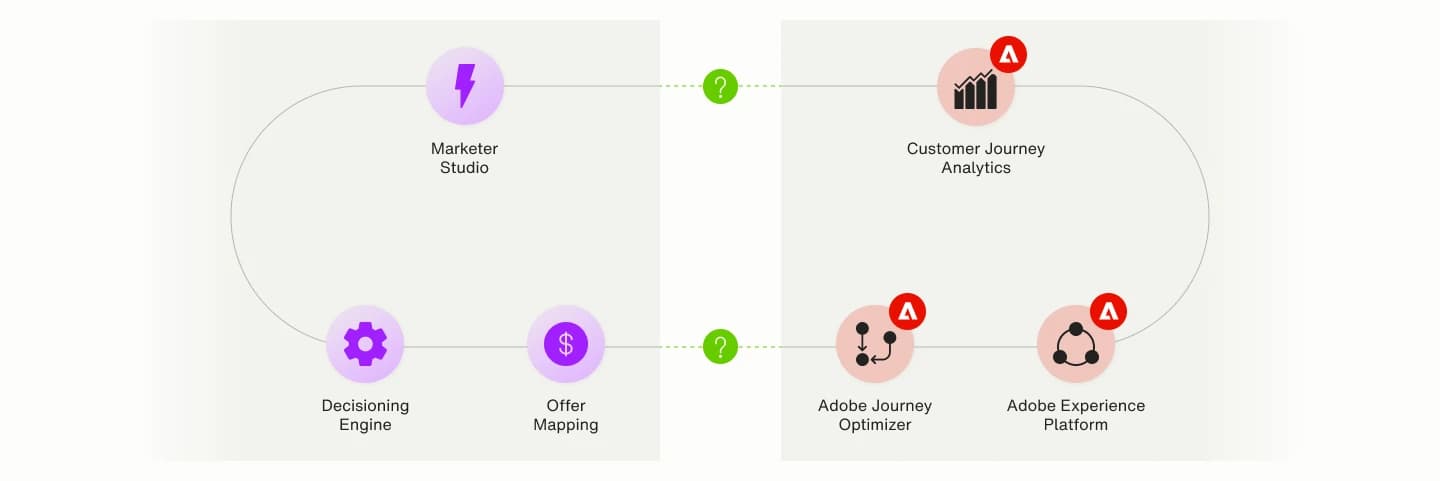
The client wasn't starting from scratch. Adobe Experience Platform, Journey Optimizer and Customer Journey Analytics were already part of its marketing infrastructure. The data was there, the toolchain was in place and the intent to act was strong. TELUS Digital, an Adobe Gold Partner with over 100 enterprise implementations, built the real-time decisioning layer that connected them.
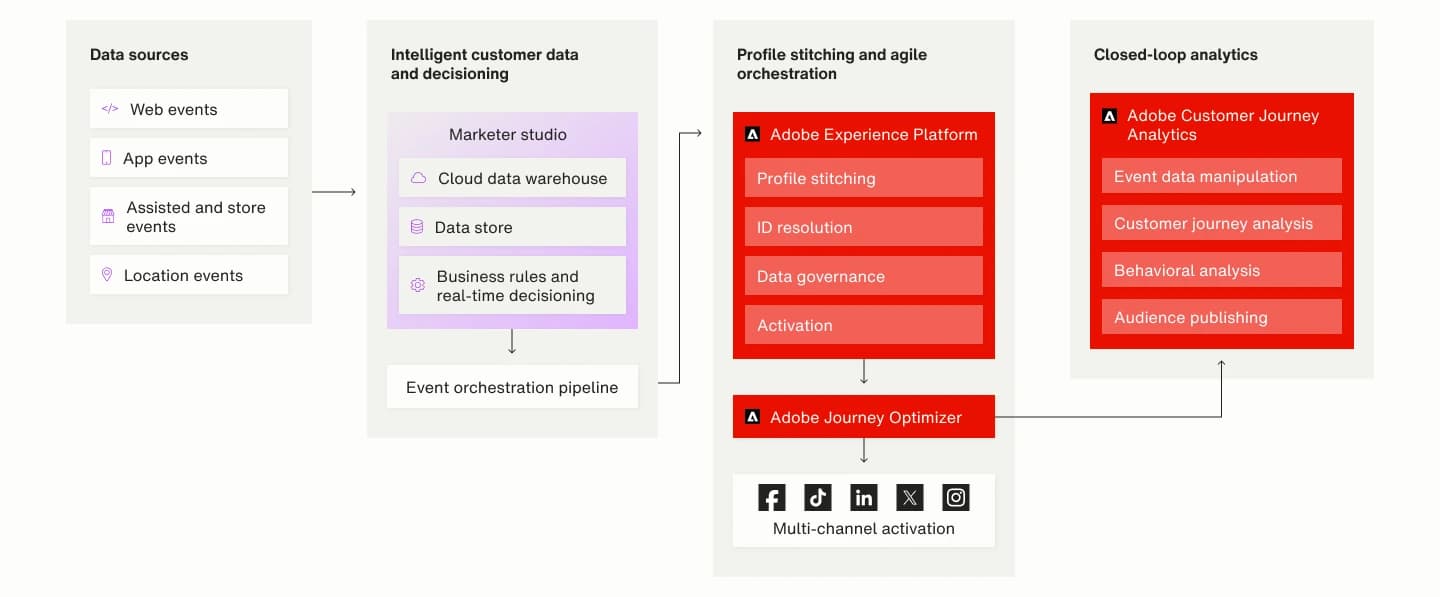
The implementation team began with a full audit of the existing infrastructure, and the solution integrated three components:
Marketer studio
The team built a self-serve orchestration hub to replace the manual campaign build process. This allows marketers to configure triggers, audience criteria and offer logic through a single interface without engineering tickets or spreadsheets.
Real-time decisioning engine
When a subscriber with high lifetime value abandons a cart, this engine qualifies them against segment criteria and maps them to the highest-converting recovery offer in seconds. What was once a manual Excel offer matrix is now a fully automated decisioning layer, hosted on Google Cloud Platform (GCP) and connected to the Adobe stack via Event Forwarding, through Adobe Experience Platform Edge Network.
New flow: Adobe Experience Platform → Journey Optimizer → Customer Journey Analytics
From GCP, resolved customer intelligence flows directly into Adobe Experience Platform. There, it's assembled into a unified profile, built from behavioral history, segment membership, channel preferences and offer eligibility. Adobe Journey Optimizer acts as the orchestration layer, evaluating whether to send a message and through which channel (and when).
In this implementation, real-time doesn't mean instant. It means right-time. Journey Optimizer evaluates timing, recency and channel fit before executing. Customer Journey Analytics closes the loop, tracking conversion, offering variant performance and channel attribution so each campaign feeds the next with sharper intelligence.
The results
The operational shift was immediate. Campaign response time compressed from 15 days to under 60 minutes. Cart abandonment recovery conversion rates reached up to 10%, driven by intercepting customers before purchase intent had faded. This program is projected to generate approximately $23.4M in revenue benefit over three years, converting what were previously silent losses into recovered sales and reinforced loyalty.
The architecture built to deliver these results is also the foundation for what comes next: activating dedicated AI agents, with human marketers in the loop, to continuously define audience criteria and offer constraints, optimizing against live enterprise signals. Networks of specialized agents can handle each layer of the pipeline, from signal detection and audience qualification to offer decisioning and journey orchestration, within defined guardrails. Adobe Experience Platform, Journey Optimizer and the real-time decisioning layer built for this program are exactly the infrastructure that makes it possible.
We enable every layer of our ecosystem’s architecture with autonomous agents working collaboratively, so we can relieve our marketers of routine configuration work that they’re doing today.
Closing a 15-day gap to 60 minutes requires knowing what your existing tools are capable of and the expertise to make it happen. TELUS Digital's Adobe practice has helped enterprise clients across telecom, retail and financial services connect the data they have and the experiences they can deliver. If that's a conversation you need to have, reach out to our experts.