Contact center AI transformation: The case for an architecture audit and a lighthouse build

Key takeaways
- Customer experience (CX) AI projects commonly stall not because of the technology, but because AI gets layered onto fragmented systems that were already failing.
- An architecture audit maps where there are integration gaps, data silos and workflow failures before AI applications are deployed.
- Not a pilot, a lighthouse build is a full production deployment in the department with the greatest need. That could be the area with the least desirable margins, the lowest customer satisfaction (CSAT), the highest agent attrition.
- A Customer Experience Strategy Assessment (CXSA) from TELUS Digital provides the diagnostic foundation for an architecture audit, connecting current-state gaps to a transformation roadmap built on the SMART CX framework.
The organizations making the most progress on CX AI transformation share a specific discipline: they started somewhere deliberate. They didn't initiate a slow, sweeping enterprise rollout all at once or hesitate, waiting for perfect conditions that might not arrive. Instead, they identified the business unit with the greatest opportunity for improvement, mapped what was already in place and implemented AI solutions there first.
The businesses that stall usually have plenty of ambition. What they need is that precise focus and discipline.
Two typical failure modes pull organizations in opposite directions:
- Moving too fast: AI gets deployed across channels before there's a working picture of how those channels connect; the result is live, but directionless.
- Moving too slowly: Organizations get stuck in approval cycles and vendor evaluations, waiting for a plan that feels certain enough to commit to at scale; the result is no deployment at all, and no progress toward one.
Neither produces the AI performance that leadership is looking for.
Nuri Gocay, director of contact center platform architecture at Zendesk, describes the architecture audit and the lighthouse build approach as the path through both failure modes. He addressed the concept on TELUS Digital’s Questions for now podcast in the episode “How do you move from chaos to clarity with CX AI?”
This article walks through how each approach works, how they connect and how TELUS Digital puts them into practice.
Why siloed AI deployments create more problems than they solve
When CX leaders are under pressure to hit performance targets, the instinct is often to add technology to the parts that hurt most. A chatbot here, a routing update there or an AI summarization tool layered onto a ticketing platform that was never designed to share data with anything else.
The result of doing this is what Gocay calls “digitized chaos” — systems that each hold their own version of the customer, workflows that break at the handoff between platforms and AI making decisions without access to the full picture of each interaction. “Putting AI on top of silos isn’t transformation,” he says. “AI can't do the best for your business if it can't see all parts of it. Just like the inefficiencies that are caused by having agents in separate pools, you can't blend them together and realize the efficiency of that entire pool.”
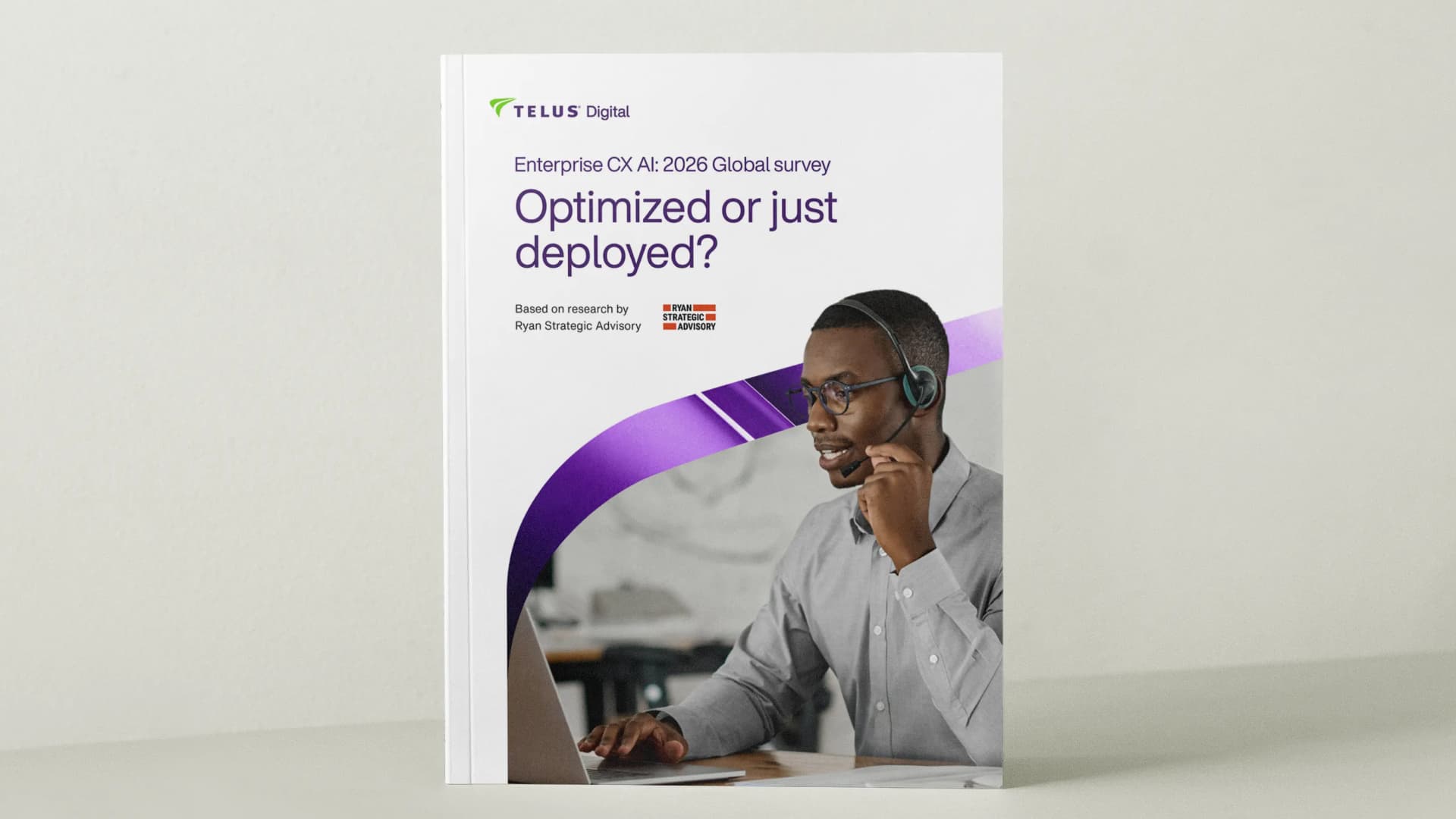
This gap between AI potential and AI performance is well-documented. The Enterprise CX AI: 2026 Global survey, research commissioned by TELUS Digital, found that only 36% of enterprises currently have AI copilots for real-time agent assistance deployed, against 56% who plan to prioritize the capability. The same gap repeats across every foundational optimization layer measured.
Enterprise CX AI: 2026 Global survey

Unused AI features, disconnected data and underbuilt workflows leave measurable value on the table. The architecture audit is the mechanism for identifying where, specifically, that value is being left behind.
What is an architecture audit? It starts with strategy, not technology
An architecture audit is a structured assessment of your current technology stack, integrations and workflows to find where systems break down and where a unified deployment would have the greatest impact before any AI gets deployed.
At TELUS Digital, the architecture audit isn’t a standalone exercise. It can be seen as one component of a broader diagnostic we refer to as a Customer Experience Strategy Assessment (CXSA).
A CXSA is the overarching framework for making sure that your business goals of the future are realistically grounded in what it will take to get there. It’s a specialized, structured diagnostic built on the SMART CX framework that evaluates strategy, operations, people and technology across five pillars:
- Strategy & Value Capture
- Modern Channels
- Agent Enablement
- Revenue Growth
- Tech Foundations
Gaps in the overall architecture cause system delays for the business and friction for the customers who are trying to use products and services.
Within Tech Foundations specifically, the architecture audit is the technical deep-dive. It includes mapping your current stack, surfacing gaps between where you are and where your integrations need to be and identifying where AI can do the most work to streamline the experience and drive revenue uplift. Rather than evaluating vendors, it maps where your current environment is breaking down and where a more integrated deployment would have the most measurable impact.
Pillar | What it covers |
|---|---|
Strategy & Value Capture | Connecting CX strategy to business goals and revenue outcomes through insights tied to key metrics. |
Modern Channels | Unifying digital and traditional channels to reach customers at their preferred touchpoints — bridging contact center intelligence with your product backlog. |
Agent Enablement | Boosting agent performance and efficiency with real-time insights, streamlined workflows and AI-enhanced tools for fast issue resolution. |
Revenue Growth | Building clear, ROI-backed business cases for investment in digital tools, CX initiatives and operational improvements across the SMART CX framework. |
Tech Foundations | Accelerating CX maturity with future-ready infrastructure and data systems that enable scalable, data-driven decisions enterprise-wide. |
Abby Spahich, VP of CX transformation at TELUS Digital, describes what that diagnostic looks like in practice: “Before we recommend any technology, we need to understand the state of what’s already in place. The CXSA isn’t a gap analysis in the traditional sense. It’s about understanding the relationship between your current systems, your workflows and the actual moments where customers fall through the cracks.”
The CXSA connects technology gaps to business outcomes. For example, where your CSAT scores are lowest, where resolution rates lag or where your agents are spending time on tasks that could be automated. It builds the case for where to start and sets the metrics that will define whether the first deployment worked.
Without this step, you’re deploying solutions before you’ve correctly identified the problem. The lighthouse build that follows is only as precise as the audit that precedes it.
What is a lighthouse build?
The architecture audit goes beyond mapping your current environment to identify where the lighthouse build should happen. Think of it this way: the CXSA surfaces the department with the most acute need, and that’s where the lighthouse goes.
“What is that one business unit you have that maybe bleeds the most margin or has the worst CSAT scores or the most employee turnover?” asks Gocay. “Let’s deploy our unified stack there, our resolution learning loop, our vision for customer experience and let’s attack that. Let’s figure out those problems and let’s see what actually happens.”
The lighthouse build is not a pilot. Pilots are designed to test whether something should be adopted — they're built for evaluation, with an exit ramp if results disappoint. A lighthouse build deploys the right combination of technology, strategy and human expertise where your operational pressure is highest, treating performance in that environment as the proof of concept.
A well-run pilot in 2026 operates under real conditions with live customers, real queues, measurable outcomes. The difference with a lighthouse build isn't rigor; it's intent. A pilot is designed to evaluate before committing. A lighthouse build assumes the commitment is already made and deploys accordingly.
“Organizations that try to transform everything at once usually don’t transform anything at all,” Spahich says, describing the pacing discipline that makes the lighthouse work. “The marathon metaphor is apt here. You build endurance in stages, with a plan, not by sprinting the first mile and hoping the rest takes care of itself. The lighthouse is the first mile done right.”
The goal of the lighthouse build is not to address one department’s highest-priority need only; it’s to build the evidence that drives enterprise demand. Once other leaders see what that one department is doing, now operating with more predictive CX, they won’t just be asking for a global rollout. “They’re going to be demanding it,” says Gocay.
What a unified stack looks like in a lighthouse build
Technology selection in the lighthouse is not incidental. It’s designed from the outset around the specific gaps the architecture audit identified.
A unified stack replaces the fragmented approach with an integrated platform that shares data across channels, routes intelligently and gives agents a complete view of every interaction. The specific composition of that stack varies by organization and implementation partner.
This is where a CX implementation partner with deep platform delivery experience makes a material difference. One that has built across a range of environments and knows which configurations translate to outcomes is far better positioned to get it right. When TELUS Digital deploys a CX AI lighthouse build, the technology stack is determined by what the architecture audit found. The stack is the specific combination of capabilities that addresses the highest-opportunity gaps in your most critical department.
For most organizations, that means replacing fragmented channel tools with a unified CCaaS platform, adding AI-powered agent tools that surface the right information in the moment it's needed and connecting a resolution learning loop that compounds its intelligence with every customer interaction. Workforce optimization may follow, or lead, depending on where the audit identified the most pressure. What is consistent across every TELUS Digital lighthouse build is AI security testing through Fuel iX™ Fortify. This proprietary TELUS Digital capability identifies vulnerabilities before they reach production, ensuring the deployment is secure from day one.
A lighthouse build treats the human layer with the same rigor as the technical one, because CX transformation is the goal, not just deploying technology. Agent training, workflow redesign and change management are scoped alongside the stack, not bolted on after go-live. TELUS Digital's forward-deployed engineers remain embedded in the department through this phase, working shoulder-to-shoulder with agents, iterating on tools based on live feedback and treating adoption as a core KPI from day one, not a byproduct of implementation.
What the unified stack produces — resolution data, deflection rates, agent performance — flows directly back to the metrics the architecture audit established before the lighthouse launched.
Measuring the lighthouse and building the case for rollout
The metrics that matter in your lighthouse build are the ones identified during the architecture audit. “Start small, start focused, measure often,” Gocay says. “Come into it with an idea of those metrics that you want to improve, and then let those be your North Star as you track toward it.”
In the contact center context, those metrics typically include CSAT scores, first contact resolution rate, ticket deflection rates and agent retention in the affected department. Improvement across these metrics won’t all move at the same pace. The architecture audit will have identified which ones represent the greatest opportunity, and the lighthouse tracks them from day one.
The lighthouse becomes the case for rollout through observed performance. CX metrics are a starting point, but what gets the attention of the C-suite is what those metrics translate to: lower cost-to-serve, improved customer retention and a measurable return on AI investment. When the lighthouse demonstrates that kind of business value, what began as a contact center conversation crosses departmental lines.
At that point, an enterprise rollout becomes a business imperative.
Launch your lighthouse build with TELUS Digital
The architecture audit identifies where to start; the lighthouse build proves the case, working together as a discipline that gives CX leaders a path to AI transformation that is deliberate, measurable and scalable.
TELUS Digital acts as a transformation partner, not just deploying technology, but bringing the strategy, implementation and operational expertise to make the CX AI transformation work in the specific environment of your business. With certified expertise across leading CX platforms, TELUS Digital brings the delivery depth to move from strategy to production.
What TELUS Digital brings to your lighthouse:
- Customer Experience Strategy Assessment: A CXSA maps your current stack, identifies integration gaps and pinpoints the department where a unified deployment will have the highest impact. The SMART CX framework connects current-state findings to a prioritized transformation roadmap.
- Lighthouse build expertise: End-to-end deployment from CCaaS implementation to go-live, with the operational discipline to build in your highest-pain environment and produce results that speak for themselves.
- Platform expertise: Deep implementation knowledge that goes beyond configuration, including, for example, setting up Zendesk’s AI capabilities, knowledge base and ticketing systems to work as a unified resolution engine.
- Ongoing optimization: Workforce management, agent enablement and performance analytics that keep the lighthouse improving after it has gone live, supported by forward-deployed engineers who stay embedded in the department to iterate on tools based on live agent feedback, building the case for enterprise rollout.
If you’re ready to identify your lighthouse and start building, contact us to get started with a CXSA.