The ultimate guide to Agentforce (Salesforce AI agents 101)

At Dreamforce 2024, Salesforce CEO Marc Benioff billed Agentforce as a pioneering development on AI’s evolving frontier, an innovative solution with the potential to redefine how businesses approach every aspect of their operations.
“For 25 years, we've been a force for sales, a force for service, a force for marketing, for commerce, for analytics. Well, starting now, we're also your Agentforce: A force for humans and AI agents to drive customer success together,” Benioff said during his keynote address.
Agentforce was developed with the intent of empowering businesses in every industry to “future proof” their businesses with emerging AI capabilities. Over the last year, Salesforce has pushed the envelope on artificial intelligence, weaving AI capabilities into every Customer 360 app and Industry Cloud. With Agentforce, the company seeks to realize the next stage of AI innovation, looking beyond the recognized limitations of existing AI assistants to debut fully-autonomous AI agents.
“41% of [employees’] time seems to be wasted on low value and repetitive tasks,” Benioff noted during his keynote. “We want to address that. Customers are expecting more zero hold times, [for engagements] to be more personal and empathetic, to work with an expert all the time, to instantly schedule things. That's our vision, our dream, for these agents.”
While the technology is in its early days, its potential has already been confirmed by Salesforce customers. As noted by Benioff during his keynote, Wiley University’s financial aid department was able to turbocharge its service operations and solve a whopping 40% more service cases during its peak back-to-school season after implementing Agentforce. The university’s success proves that Agentforce can empower businesses to turbocharge their sales and service teams without burning out their employees.
But amid all the hype, you may be wondering: What is Agentforce, and what does it do? In this article, we’ll unpack everything you need to know about Agentforce, including its definition, potential use cases, how to build an agent and what you can do to get started with the platform.
What is Agentforce?
Agentforce is an autonomous system built on Salesforce and powered by LLMs, designed to help businesses harness advanced, agentic AI to automate processes, make plans and take action based on real-time data. Agents created with Agentforce can be leveraged internally (to help employees) or externally (to enhance customer experiences).
Agentforce has the following characteristics.
- Autonomous: Able to handle complex tasks (i.e., customer support, marketing tasks, scheduling or sales assistance) without human intervention
- Adaptable: Capable of using real-time data changes and evolving external market or organization conditions to guide decision-making and prompt action (i.e., adjusting pricing, launching campaigns)
- Advanced: Able to use its deep language understanding to interpret complex user requests and generate natural-sounding responses
- Assistive: Able to use reasoning to help agents make informed decisions and respond appropriately to dynamic circumstances.
- Consistent: Able to function 24/7
Unlike run-of-the-mill AI assistants and chatbots, Salesforce Agents can orchestrate actions, stitching disparate tasks together to perform complex work (e.g., updating records, booking appointments, answering FAQs). These “AI employees” access data and execute logic through “flow” (an application that accepts inputs and takes action accordingly) and “Apex” (a programming language). This orchestration allows agents to solve problems on the fly — even if the issues that occur aren’t ones the Agent was specifically programmed to address.
The importance of this improvisational ability cannot be understated. Historically, developers who intend to build a program have needed to proactively think through interactions, building countless flowcharts to clearly articulate responses for every “if X happens, do Y” eventuality. But despite developers’ herculean efforts to plan for everything, mapping out every possible engagement simply isn’t feasible; at some point, the program will encounter an unmapped scenario.
But with Agentforce — and more specifically, the Atlas reasoning engine that powers it — Salesforce customers can sidestep that extended planning process, leaving the wargaming to the system.
“Atlas simulates how humans think, plan and take actions. It starts from evaluating users’ requests and the context, refining them for clarity. From there, it retrieves the most relevant data from your business, your CRM and your Data Cloud [since rebranded to Data 360]” Claire Cheng, vice president for data science and engineering at Salesforce explained during the Agentforce keynote at Dreamforce 2024.
The boost that Data 360 provides, which Cheng alludes to in her quote, deserves some unpacking. Data 360 isn’t strictly necessary for customers who want to take advantage of Agentforce; Agents can provide tremendous value if applied within any core Salesforce product (e.g., Sales Cloud, Service Cloud, Manufacturing Cloud, Financial Services Cloud, etc.). However, Agents achieve optimal results when enabled by Data 360.
What can Data 360 and retrieval augmented generation do for Agentforce?
Data 360 is a solution that allows businesses to funnel significant volumes of data from internal and external data sources into their Salesforce org by way of declarative connectors and programmatic APIs. In doing so, the solution is able to create comprehensive customer profiles that update in near real time to account for new information and customer activity.
Data 360 also harmonizes structured data (e.g., information stored in databases, tables, etc.) and unstructured data (e.g., documents, knowledge articles, product descriptions, audio and video files, etc.) for intelligent marketing, tailored experience creation and — of course — AI Agent creation. By uploading critical external documentation and resources to Data 360, customers can ensure that all agent-generated outputs are perfectly contextualized, accurate and relevant.
That said, Data 360 isn’t a strict requirement for customers who want to take full advantage of Agentforce. Salesforce’s retrieval augmented generation (RAG) feature allows users to funnel relevant unstructured data into Salesforce and ground prompts in enterprise data to generate more relevant and impactful results.
RAG provides value by:
- Decreasing the likelihood of hallucinogenic output
- Respecting user privilege levels; users can’t use data they don’t have access to
- Allowing for data quotation and citation
- Updating information without the need for model retraining
Salesforce Agents operate most effectively when empowered by Data 360; however, we advise that companies interested in Agentforce work with a partner like TELUS Digital to clarify whether implementing Data 360 is necessary to their transformation goals.
What’s the difference between Salesforce Agents and Copilot?
Agentforce is an AI system and offerings category that includes, but is not synonymous with, Einstein Copilot. Einstein Copilot is just that — a copilot, an employee’s second set of hands. It functions primarily as a virtual assistant and can execute activities (e.g., auto-generating email copy, surfacing customer information, suggesting next-best-actions) to improve employee efficiency and improve productivity.
Salesforce bills its Agents as the next and most logical progression in assistive AI innovation; unlike Einstein Copilot, Salesforce Agents can operate autonomously and serve a wide variety of functions for sales, marketing and service teams. Salesforce’s Agents distinguish themselves from other emerging AI tools by being comparably easy to establish; users can rapidly assemble agent functionality with pre-built templates, workflows and no-code actions.
Most notably, agents are highly customizable and can be applied to a near-infinite number of business use cases. Agentforce is intended to put the imaginative power of AI enablement directly into users’ hands.
Salesforce customers have the ability to determine every aspect of an agent’s applications and achievement by:
- Defining the topics that the agent can assist with
- Providing instructions on what the agent should do
- Giving the Agent access to data, so it becomes knowledgeable about the business and provides relevant (and helpful!) outputs
- Assigning actions to clarify what the Agent can do autonomously
- Establishing guardrails to ensure that the Agent acts within set limits
- Exposing agents to appropriate channels, so they can interact and fulfill their intended purpose
As Gary Brandeleer, a senior product director in Salesforce’s AI division, explained during the Agentforce keynote: “The possibilities are truly endless. You can configure and customize these agents at every level. At the agent level, the topic level, the action level; it’s up to you to decide what they are going to do.”
Salesforce Agents: What do you need to know?
It’s important to note that Salesforce’s Agents are not intended to replace human agents, but rather free human employees from routine tasks so they can do more of what they do best: build relationships and sell. According to Salesforce’s 2024 State of Sales Report, sales reps spend, on average, just 30% of their week selling — the majority of the time, they say, is taken up by “tedious and manual tasks.”
By taking advantage of AI agentic support, businesses can alleviate the burden that rote, manual tasks pose to everyday workloads, enable employees to dedicate their time to activities that need their expertise, and boost overall productivity.
“Every AI conversation needs to be an ROI conversation, and that will happen only when AI augments your team to accelerate growth,” Ketan Karkhanis, executive vice president and general manager of Sales Cloud, commented in an announcement about Salesforce’s emerging AI agents. “Every sales team needs more at-bats and more enablement to accelerate close rates, and that’s what these new autonomous sales agents will help drive. The sales team of the future is humans working with AI to drive sales success.”
With Agentforce, companies can build agents to suit a variety of use cases for sales, service and marketing. However, it’s worth noting that the company has already unveiled multiple purpose-built agents that can be used out-of-the-box, with little need for individual customization. In the following sections, we’ll be “unboxing” two: Einstein Sales Development Rep (SDR) and Einstein Sales Coach.
Agent 101: What is an Einstein SDR Agent?
Einstein SDR Agents are “digital employees” that can tackle engage with inbound prospects and nurture pipeline 24/7. These agents can generate fully-contextualized, trustworthy and helpful responses by drawing upon internal CRM and harmonized external data via Salesforce’s RAG service. As such, the agents have the means to take — or facilitate — engagement with multiple leads across channels and in a variety of languages.
By tackling time-consuming sales activities, SDR agents give human sales employees more time to do what they do best: build long-term, lucrative relationships with customers.
Einstein SDR Agents can:
- Handle time-consuming, top-of-funnel sales activities
- Analyze prospect questions to generate fully-contextualized, situationally-appropriate answers and recommendations
- Autonomously determine and precipitate common actions (e.g., scheduling meetings, handling low-level complaints or objections, responding to product questions)
Agent 101: What is an Einstein Sales Coach?
Salesforce’s Einstein Sales Coach Agents are your employees’ cheerleaders and upskilling enablers. Designed with your team’s professional development in mind, Einstein Sales Coaches give sales reps the opportunity to simulate sales conversations, prepare for calls and hone their conversational skills in a safe, no-risk setting.
By drawing upon real customer details (e.g., deal, account, previous engagement information) and using text-to-speech conversion to “converse” with reps, Sales Coaches can facilitate realistic dry runs that empower your employees to better prepare and ace their customer calls.
Einstein Sales Coach Agents can:
- Facilitate role-plays that take deal and customer details into account
- Provide personalized and objective feedback during customer calls
- Flexibly simulate common interactions including pitches, objections and negotiations
As of writing, Salesforce plans to debut its SDR and Sales Coach Agents in October 2024, with additional updates expected to occur in forthcoming months.
Salesforce Agents 101
Focused on | Able to | Restrictions | |
|---|---|---|---|
Sales Development Representative (SDR) Agent |
|
|
|
Service Agent |
|
|
|
Sales Coach |
|
|
|
Einstein Copilot |
|
|
|
How to build an Agentforce Agent
Like all Salesforce products, Einstein Agents are designed to be accessible and, given some platform knowledge, easy to create without code or specialized training. Organizations can develop best-in-class agents for a variety of use cases across sales, service and marketing.
For all, the process will follow the same five steps.
- Clarify roles: Hone in on the use case and purpose the agent will be serving for your organization; define topics, KPIs and a “scope” for the agent’s actions.
- Identify critical data: Identify the data the agent will need to successfully complete desired actions; determine whether your data is complete and ready to use.
- Define instructions and guardrails: Set operational guidelines for agents by defining core instructions for each topic.
- Develop actions: Use Apex, Flows and Prompts to build automations that your agent can call upon to achieve its designated goals.
- Select channel: Expose your Agent to appropriate channel(s) (e.g., internal systems, Experience Cloud portal, Slack, public website) so they can fulfill their designated purpose.
Let's put this into perspective with a practical service example: how a business might use Agentforce to build an autonomous AI chatbot that answers basic customer questions and schedules service appointments in a natural, conversational way.
Want to watch a full agent creation demo? Check out this video or visit Salesforce’s Agentforce homepage.
Chat interaction: An Agent schedules a service appointment
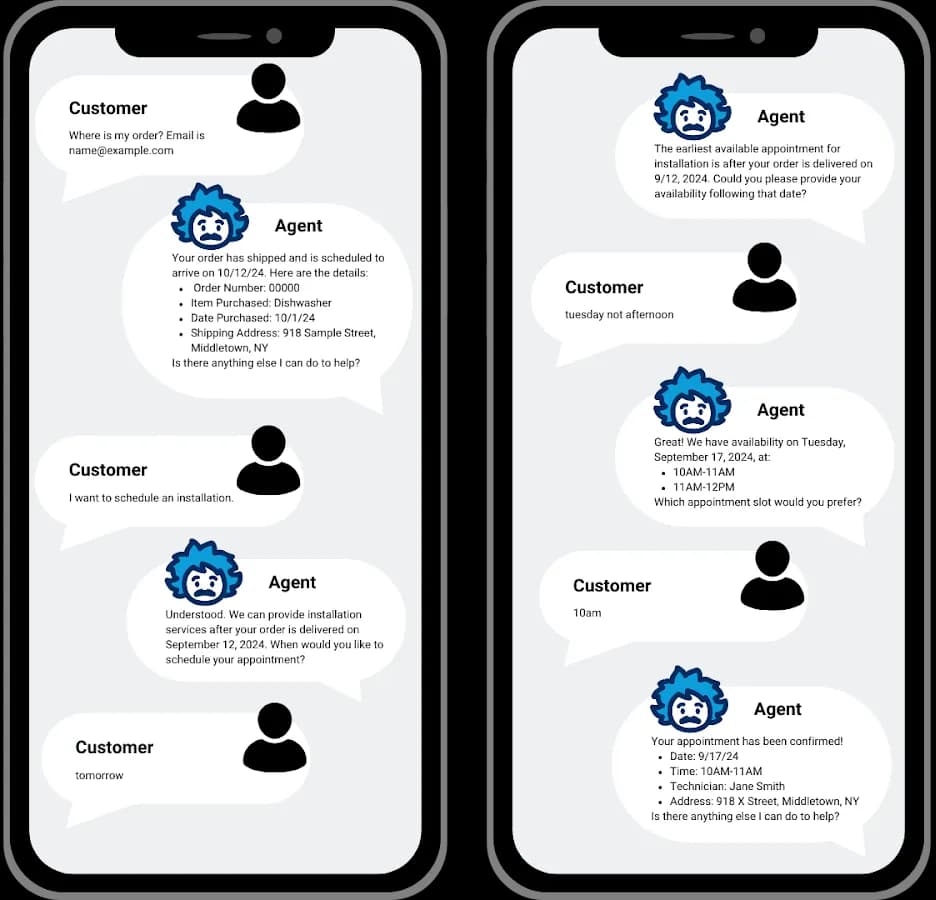
What’s notable about this interaction?
While most conventional chatbots are only able to handle one or two defined tasks (e.g., scheduling an appointment, answering basic FAQs), a Salesforce Agent can autonomously pivot between distinct tasks (topics) to resolve all aspects of a basic customer service engagement without needing to loop in a human representative.
During this sample conversation, the agent autonomously and automatically:
- Referenced CRM data to surface details about the customer’s order and pending delivery
- Autonomously pivoted topics based on customer input, seamlessly reclassifying the engagement in real time from order management to appointment scheduling
- Proactively identified that the customer’s stated time preference would create a problem (e.g., the service representative would arrive before the appliance) and recommended a more appropriate service window
- Processed potentially confusing natural language (e.g., “tomorrow not afternoon”) to provide an appropriate recommendation
Agentforce gives businesses unprecedented access to emerging AI, allowing them to harness the technology to not only free employees from time-consuming manual tasks, but also deliver exceptional customer self-service experiences at scale.
Turbocharge Agentforce achievement with TELUS Digital
Agentforce promises to redefine how businesses approach day-to-day sales and service operations — and at TELUS Digital, we’re ready to help you take full advantage of the opportunity. We have built a team that features talented consultants with a collective wealth of cross-industry, cross-Cloud experience.
TELUS Digital can deliver:
- Seamless, strategic deployment of intelligent agents within your Salesforce environment
- Fast, effective deployment of an Agentforce AI agent tailored to your unique business needs, integrated with Salesforce products and set up with scalability in mind
- Comprehensive knowledge transfer, enabling your team to confidently operate and manage AI agents
- Continuous support to ensure ongoing value as you optimize and refine your AI agents post-deployment
- AI discovery workshops and org assessment to assess your AI and data readiness and explore customized opportunities for further automation and efficiency
We’re here to help. If your business wants to start taking advantage of Agentforce, schedule a conversation.