What it takes to run a field operational testing program for L3-L4 AVs

Product Manager, Field Operations Testing, TELUS Digital
Key takeaways
- Field operational testing (FOT) is the mandatory, real-world validation stage before an advanced driver assistance system (ADAS) or automated driving system (ADS) reaches production, required by UNECE WP.29, SOTIF (ISO 21448) and FuSa (ISO 26262).
- Moving from ADAS (L1-L2) to ADS (L3-L4) multiplies the scenarios, regions and edge cases you need on record, along with the physical infrastructure required to cover them.
- Running a global FOT program for L3-L4 AVs and systems means covering four workstreams at once: fleet and regulatory, people, route and safety operations and data infrastructure.
- The right program replaces guesswork with live gap analysis against your operational design domain (ODD), so mileage buys new scenarios instead of duplicating ones you already have.
- TELUS Digital runs global FOT programs in over 50 countries and offloads more than 20 TB of sensor data per vehicle per day into anonymized, annotation-ready datasets.
Autonomous driving is the ultimate open-world problem, converging unbounded scene variations, sudden downpours, shifting geography and the chaotic creativity of human drivers. Before an ADAS or ADS can reach production, regulators require proof that it works in the real world, not just in simulation.
The United Nations Economic Commission for Europe’s WP.29 (UN Regulation R157) makes field operational testing (FOT) mandatory: virtual simulation and closed-track testing, backed by extensive real-world driving trials and continuous in-service monitoring once the system ships.
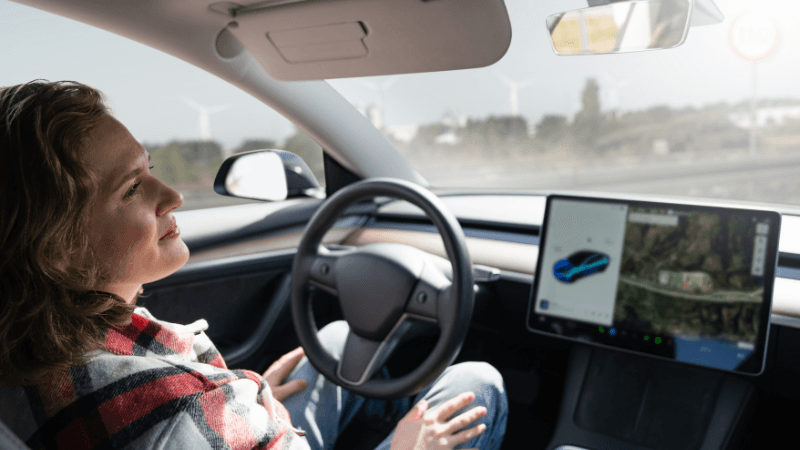
A handful of AV leaders already stream data from millions of consumer vehicles on the road today (e.g., Tesla’s shadow mode), a head start most automakers can’t replicate without their own installed base. Every other automaker and AV developer training, validating and certifying next-generation perception and motion-planning models has to collect that data manually. That means millions of kilometers across regions and conditions their models still haven’t seen.
Those data needs become more complex as AVs do. Moving from driver assistance and partial driving automation (L1-L2) to conditional and high automation (L3-L4) multiplies the scenarios you have to investigate. Compliance with SOTIF (ISO 21448) and FuSa (ISO 26262) also means that coverage must be traceable, not just claimed. In practice, that means operating four workstreams at once:
FOT workstream | What it covers |
|---|---|
Fleet and regulatory | Vehicles acquired, registered, insured and moved across borders, cleared through the customs, privacy and automotive compliance requirements of every market you test in. |
People | Professional drivers hired, trained and rotated through shifts, plus local technical talent who understand regional driving norms and keep the fleet on the road. |
Route and safety ops | Route plans that target ODD gaps instead of accumulating redundant miles, with live tracking to flag disengagements and coordinate field support when something goes wrong. |
Data and infrastructure | Terabytes of sensor data per vehicle per day, offloaded, anonymized and curated into annotation-ready datasets, on top of the workshops and complex hardware integration that keep multi-sensor rigs calibrated across every regional fleet. |
This is where many L3-L4 AV programs stall, weighed down by the realities of building and staffing FOT infrastructure in-house while still shipping core perception and planning models on schedule. Once that infrastructure starts competing for engineering time rather than supporting it, bringing in an FOT partner makes sense.
TELUS Digital runs global FOT programs end-to-end in more than 50 countries as part of our Data for Automotive AI practice. This includes low-access markets like Eastern Europe, the Balkans, East Asia and Latin America, where novel driving scenes exist but are difficult to access for large-scale data collection. Here’s how we structure our FOT program, and what to look for if you’re evaluating an FOT partner rather than building a program in-house.
How TELUS Digital runs FOT programs for L3-L4 AVs
Our FOT program takes the four workstreams outlined above and orchestrates them into a single discipline running together, rather than four separate efforts in isolation:
- Vehicles, garages and drivers
- Route planning and optimization
- Real-time fleet tracking and edge logging
- Integrated downstream pipeline for calibration, transfer and machine learning (ML) curation
Fleet operations, route planning and tracking all surface live in a shared FOT console, letting project managers and client engineering leads watch their programs run instead of waiting on weekly status reports. By structuring our FOT program this way, we integrate our automotive clients’ physical operations and software layers from the start, so operations and software stay in step all the way to global L3-L4 validation.
Vehicles, garages and drivers
The most advanced sensor rig in the world is still only as good as the fleet driving it, creating a breaking point for many in-house FOT programs. Getting a fleet on the road means clearing customs paperwork, registering vehicles, complying with local labor laws, processing insurance claims, running driver payroll, leasing garages, calibrating sensors and handling daily data logistics — all on a market-by-market basis.
That’s often where in-house programs break, because each piece tends to sit with a different team or vendor. But when you partner with TELUS Digital, all of these pieces flow together into a single coordinated operation:
- Hardware integration: We manage sensor mounting, calibration and configuration within whatever tech stack you already run, whether that means procuring vehicles outright or operating under a bring-your-own-vehicle (BYOV) model. Workshops support camera, lidar and radar suites across passenger cars, heavy trucks, off-road vehicles and maritime platforms, with pre-drive health checks before any rig leaves the garage.
- Technical test operators: Data quality depends on who’s in the cabin. Drivers with systems-testing and data-logging backgrounds monitor Linux-based system health, run Python validation scripts and hold microsecond time synchronization across lidar, camera and inertial measurement unit (IMU) modules — the difference between catching a hardware failure mid-shift and losing a day of data to it.
- Field incident response: Our local workshop teams handle emergency notifications, vehicle recovery, insurance claims and daily issue logging straight to the program’s project managers, so a flat tire two hours outside a city doesn’t turn into a week-long gap in the dataset.
Route planning and optimization
Unguided mileage is expensive, and it doesn’t teach a model anything new. Every kilometer driven on a road already mapped is a kilometer paid for twice. We help you maximize the effectiveness of data collection before a vehicle leaves the garage, targeting specific ODD gaps rather than accumulating miles for their own sake.
- Point-of-interest discovery: Our route-planning tools let planners query target road features directly (e.g., “Find all school zones and unmapped roundabouts in Detroit”), and multi-agent algorithms automatically identify, aggregate and route the most efficient path.
- Coverage validation and gap analysis: Comparing planned routes against historical driving traces provides real-time spatial coverage, so new dispatch plans fill ODD gaps rather than covering roads already logged.
- Multi-constraint route optimization: Our routing balances live traffic, sensor payload requirements, scenario density targets and driver shift limits into a daily collection schedule.
- Collaborative review: Route previews go straight to the engineering team inside the console for comments and one-click approval before a vehicle leaves the garage.
Real-time fleet tracking and edge logging
Once vehicles are on the road, we need to know within minutes if one goes off-route, stalls or loses sensor sync — not find out the next morning from a report. That requires pairing high-frequency telemetry with real-time operational context.
- Telemetry logging: Our route-tracking app serves as a dedicated telemetry hub inside each vehicle, logging latitude, longitude, speed, distance and duration locally at 1 Hz. The app uploads on 10-meter displacement or a forced one-minute heartbeat, whichever comes first, and tags each segment with real-time weather, lighting conditions and road type (i.e., highway, city, rural) as it’s collected. That’s metadata captured at the source, not reconstructed after the fact.
- Operational anomalies as signals: Traffic congestion, bio breaks, fuel stops and technical hiccups aren’t just downtime, they’re longtail signals worth logging against predefined reasons (e.g., traffic, bio break, scheduled break, fueling/charging, technical/sensor issue, vehicle breakdown, custom). These trigger a live pause timer on the central console.
- Incident reporting: Our field operators report road blockages, unexpected construction or sensor anomalies from a simple in-app interface, so an edge event doesn’t disappear from the record.
- Driver-side system monitoring: Technical test drivers monitor Linux-based system health, run automated test scripts and hold precise time synchronization across overlapping sensor arrays to catch hardware failures before they go silent.
FOT console: Centralized mission control
The FOT console ingests real-time streams from edge-tracking and route-planning systems into a single workspace. A weekly status report may tell you where a fleet was seven days ago, but the FOT console shows your project managers and client engineering leads where the fleet is now.
- Governance and coverage heatmaps: Role-based access lets client stakeholders see live coverage metrics, fleet performance and route progress in a workspace scoped to their program. Heatmaps break down by country, city, weather, road class and day/night ratio. If a heatmap shows an under-represented condition, planners can redirect next week’s routes immediately.
- Vehicle and incident diagnostics: Provides drill-down visibility into per-vehicle uptime, synchronized telemetry and planned-versus-actual routes. When a route pauses or a safety incident happens, event analytics classify it by reason code, track driver metrics and export compliance logs for the record.
Integrated downstream pipeline: Calibration, transfer and ML curation
Collecting data is only half the job. None of it creates value until data moves from a regional workshop’s hard drive into a pipeline that turns raw sensor capture into training-ready datasets. All of that depends on a few disciplines we run in sequence: synchronized capture, secure transfer, intelligent curation and consistent annotation.
- Synchronization and calibration: We jointly hardware-trigger and timestamp cameras, lidar, radar and IMUs at capture, on a unified keyframe rate with ego-motion compensation applied across lidar sweeps to prevent point-cloud distortion. From there, we re-verify calibration per log file because sensors drift physically over time, even when nothing else changes.
- Data transfer and anonymization: Multi-sensor suites generate terabytes of data per vehicle per day, so our cloud storage partnerships support automated backups with throughput exceeding 20 TB per day. Automated pipelines scrub personally identifiable information (PII) — faces, license plates — over encrypted transfer lines before curation starts, to meet GDPR and other regional privacy requirements, the same discipline we apply to any large-scale video data collection effort.
- Frame curation and scenario tagging: We filter out thousands of miles of redundant highway driving in favor of rare edge cases, complex urban maneuvers and adverse weather transitions, ranking sequences by model learning yield so the annotation budget goes to the frames that improve accuracy.
- Semantic data discovery: Our natural-language search layer lets teams pull targeted slices, like “rainy nights” or “unprotected left turns,” straight out of the dataset instead of writing a filter query for each one.
- Adaptive validation: We route human and rule-based reviewers only to attributes where model prediction confidence is already low, rather than rechecking everything.
- Annotation integrity: Every annotation team works from the same taxonomy, checked at three levels: per-track verification for object scale and classification, per-cuboid checks for exact 3D position and orientation, and full scene-video renders to catch the occlusions that interactive editors miss. See our broader approach to data annotation.
What to look for in an FOT partner or platform
The above breakdown shows how TELUS Digital runs global FOT partner programs with our clients. If you’re comparing partners or weighing whether to build a program in-house, here are the key areas you should assess:
Criterion | What good looks like |
|---|---|
Global operational depth | Garages, vehicles, insurance, customs and driver hiring are handled locally in every market you need data from. |
Intelligent route planning | Natural-language target discovery, ODD alignment and historical gap analysis, so mileage buys scenes you don't already have. |
Edge-to-cloud tracking | Real-time telemetry, automated metadata tagging, one-tap incident logging and sensor health monitoring that catches failures before they cost you a week. |
Centralized mission control | Role-based access, live coverage heatmaps and fleet uptime analytics across every active region. |
Field-to-dataset pipeline integration | High-throughput daily offloading, automated PII anonymization and ML curation that hands your team annotation-ready data. |
Field operational testing is what turns a promising perception model into one regulators and customers can trust on open roads. TELUS Digital built its FOT program this way — fleet operations, route planning, live tracking, console analytics, downstream data pipeline — so it doesn’t compete with the engineering time teams need for everything else.
If you’re deciding whether to build an FOT program in-house or bring in a partner, start by exploring how we support OEMs and AV developers with our Data for Automotive AI Solutions.