Using Palmata to boost answer engine presence: A guide to AI search optimization

Jarrod Cady
Global Vice President, Marketing
Key takeaways
- AI answer engines like ChatGPT and Gemini are shaping how buyers perceive a brand before they visit its website.
- Palmata is Salesforce's new AI discovery platform, built to explain why a brand is represented a certain way and which content changes would help.
- TELUS Digital ran Palmata on its own brand before recommending it to clients and found actionable content gaps.
- Palmata differentiates itself through five advanced capabilities: steering control, adaptive deep research, recommended actions and simulated impact.
- Review sites are among the most commonly cited sources in AI-generated brand comparisons, which makes them part of generative engine optimization (GEO), also referred to as answer engine optimization (AEO), strategy rather than a separate reputation task.
Inbound leads are the heartbeat of TELUS Digital’s business. We’re a trusted digital services provider for the world’s most admired brands, and as Head of Marketing, I'm watching the “How did you hear about us?” field change in real time. References to ChatGPT, Gemini and Claude are increasingly appearing alongside the usual referral sources and search engines, which means a growing share of the buying process now happens in AI-powered conversations we can't see and don't control.
When a buyer asks ChatGPT for a recommendation and your brand isn't in the answer or misrepresented, you’re starting from behind. An LLM assembles your reputation out of unverified content found across the web and hands a buyer a summary before they've read a word your brand wrote.
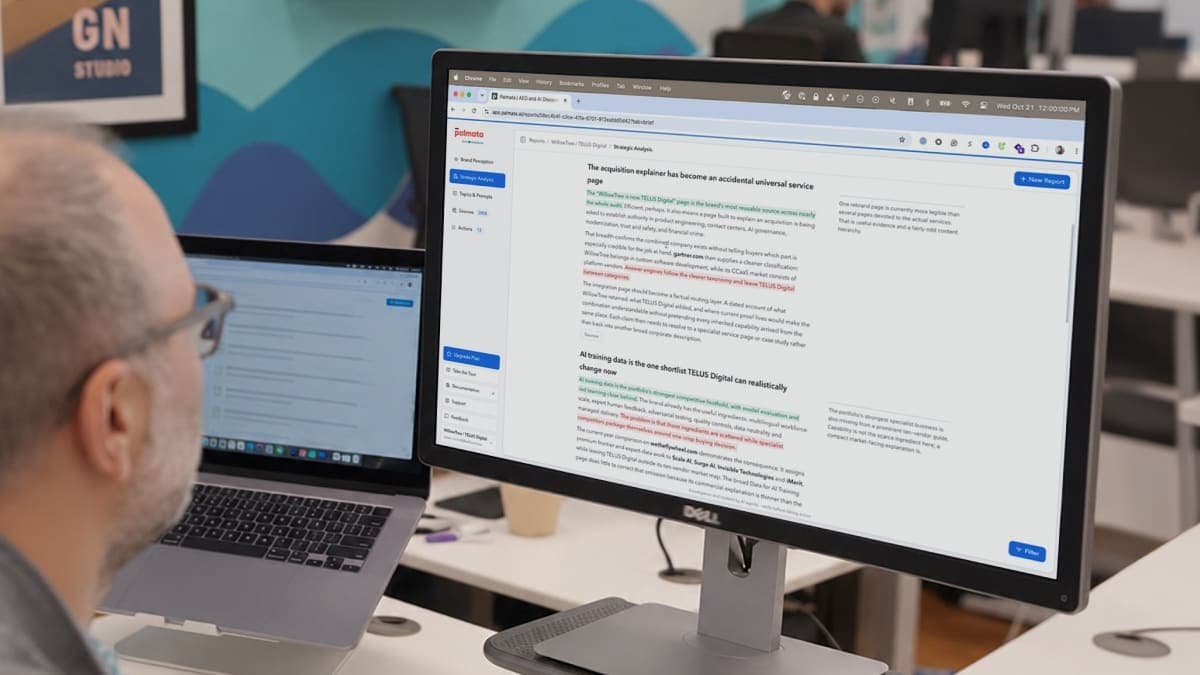
So, how do you gain traction in this developing channel? Our Generative Engine Optimization experts use robust tools like Palmata, an AI discovery platform from Salesforce and Contentful. To understand how it can help our clients, our team ran Palmata against our own brand. For marketing and content leaders deciding how to show up in AI answers, here’s what Palmata actually does, what we found and what we recommend before running a single report.
The combination of powerful Palmata technology and the GEO expertise that our teams bring to bear — whether that’s in content, content design or reputation management — collectively helps our clients win that moment that matters.Leveraging deep research: What Palmata does well
I’ve used most of the big GEO tools in the market today. What they do well is answer if and how your brand is showing up. They provide mention rate, citation rate and share of voice against competitors.
Salesforce and Contentful take tooling a step further. Their expertise in how enterprises create, structure and publish content led them to ask a more useful question that content and brand teams need answered: Why are we being described this way, and what should we fix first?

A brand can be mentioned constantly and cited nowhere, which means every description comes from third parties: review sites, forums, press, competitor comparison pages or outdated articles. Palmata leverages cases where branded content is already showing up and has a clear shot at steering the narrative.
What Palmata revealed about TELUS Digital
We’re early with Palmata. Our team is still setting up and comparing reports, so we have more work ahead in testing, validation and discovery.
But to start, we ran Palmata across our own solutions, and the results revealed notable gaps. In categories where our brand has competed for years, like customer support outsourcing, our mention rate held up well. However, there was more dimension within that category to optimize. Even though we have a strong record of running CCaaS migrations for some of the world’s biggest brands, an entire cluster of buyer prompts about migration methodology came back without us being mentioned anywhere. That gap is a starting point for new content, and it’s grounded in data rather than guesswork.
As I mentioned, review sites are an essential part of AI search reputation. Before using Palmata, we’d made a deliberate push to ask trusted clients for reviews on B2B review sites. Palmata’s “sources” view helps us check whether those are the sites AI answers actually cite, so we can understand how to adapt effort and aim it in the right places.
How prompting works in Palmata
Palmata takes a “yes, and…” approach to prompting, shifting the onus off the user. You start by making your request in a sentence or two, as you would with any other AI tool, but then Palmata uses a proprietary research agent to evaluate your brand, based on online discourse around its category, buyer personas, named competitors and product reputation. It generates hundreds of paragraph-length prompts based on steering and groups them into topics by similarity.
The resulting report is built from those topics and prompts, so you can see where you win and lose, question by question, rather than a single visibility score. Most importantly, you get actionable next steps, each one tested against Palmata’s own audit before being presented as an option.
Inside a Palmata report and its five views
A report has five views, and each answers one essential question.
View | The question it answers |
|---|---|
Brand perception | How am I doing, in three numbers? (Mentioned, Cited as source, AI perception) |
Topics and prompts | Which topics am I winning, and which am I losing? |
Sources | What’s shaping what the answer engine says? |
Actions | What do I do about it? |
Strategic analysis | How do I explain this to my team? |
Under any topic or action sits the evidence: the exact buyer question, the full answer the model gave and the sources behind it. Open a prompt to read what the answer engine actually said.
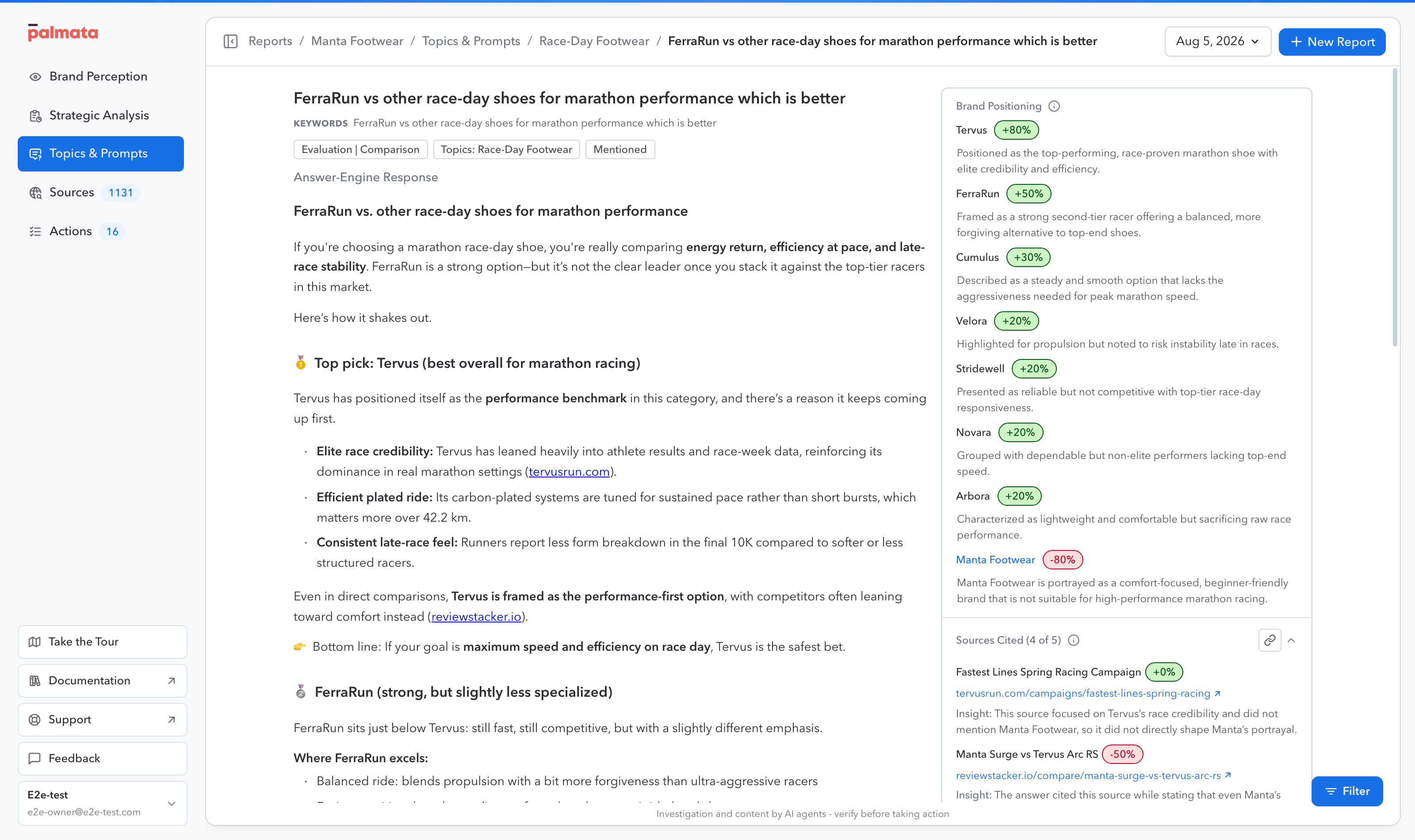
We recommend rerunning a report monthly to see what's moving. Reruns reuse your original steering and prompts, so results stay comparable: Two runs give you a month-over-month view, and successive runs unlock trend lines for mention rate, citation rate and perception.
Palmata’s differentiating features
I’ve highlighted how Palmata is different than other GEO tools I’ve used, but there are five core features that reinforce how Palmata sets itself apart as an effective strategy and content tool.
Steering control
A core feature of the tool, steering control points Palmata’s research at what matters to your business instead of a single blended brand score. That could be a specific product line, geography, market, list of competitors or buyer segment.
Here's an example:
Focus on customer experience management, specifically outsourcing contact center operations and applying AI to customer service. Separate software vendors that sell AI agents from service providers that implement them. Make sure [Competitor A] and [Competitor B] are included. Segment results across the US, Canada and France, and across enterprise and mid-market buyers.
Each sentence does a different job here. The first sentence focuses on scope, the second on disambiguation, the third on competitor steering and the last on segmentation. What’s avoided here is steering based on outcomes that are already built into Palmata itself, like: Improve our AI search score and make sure we rank first for contact center outsourcing.
This helps you generate the most targeted report possible for your needs. We’ve found it very useful to compare results when tweaking steering, such as: What if we’re interested in an IT buyer vs. a product buyer?
Prompt preview
Steering is only useful if it produces the questions you meant to ask. Prompt preview lets you check before you spend anything meaningful in credits. Palmata reads your steering and returns a sample of the topics and prompts that a full report would generate, so you can confirm they match the direction you gave it.
Adaptive deep research
Adaptive deep research is the engine behind everything else. Steering aims it, and the recommended actions and simulations come from what it finds. It turns your category into a map of buyer questions and shows where you stand on each one.
Palmata writes hundreds of prompts the way buyers ask them, runs them against ChatGPT and Gemini and groups the answers into topics. A heat map shows mention and coverage against your named competitors or the ones Palmata infers, so you can see at a glance where you win, where you lose and where you don't show up at all. The mix includes blunt, decision-stage questions, such as "Talk me out of using [brand]," because a skeptical buyer asks those types of questions, too.
Recommended actions
Recommended actions turn findings into a ranked playbook. Many of the fastest wins sit in pages an engine has already read and passed over. You don't have to earn its attention. You have to give it a reason to use you.
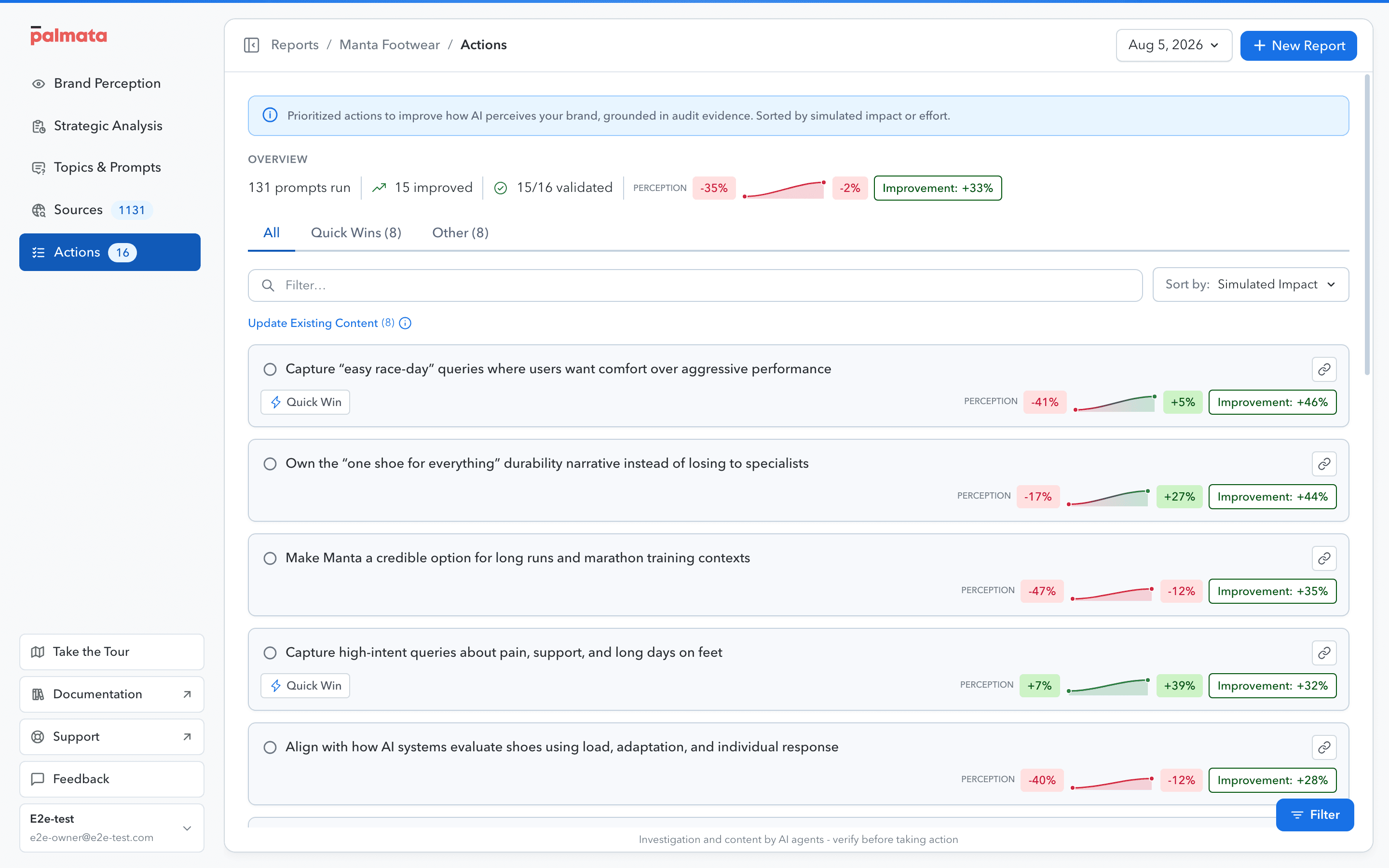
Each action is tied to the buyer questions it would change, and content edits show up as a marked-up page: red for lines that hurt how models describe you and green for proposed copy.
Actions fall into five types:
- Updating existing content: Recommendations to restructure for clarity, missing context and backing a claim with a source
- Creating new content: Recommendations on net-new pages to fill gaps where engines are answering questions about you in the absence of content
- Countering a competitor's narrative: Actions that target specific, unflattering or incorrect claims so you can reshape the narrative
- Influencing third-party sources: Reviews, directories and press shape what engines surface about you, and these recommendations provide chances to improve what those sources say or earn citations from new ones.
- Leveraging recency: Recent content tends to land better, and these actions include updated dates, current stats and recent references.
The separate sources view shows which citations help you and which work against you, so you can start with the pages already being read incorrectly.
Simulated impact
Simulated impact tests a change before you publish it. Palmata reruns the affected prompts against the proposed copy and estimates how far your perception could shift, so you're weighing a range rather than a single guess. You can edit the recommended copy to fit your brand voice and re-simulate to see whether the change still holds.
Treat the result as a directional read since models take weeks to pick up published content. So, real answers will catch up after you publish.
Three decisions before you run a Palmata report
Here’s a checklist to help frame success:
- Decide which prompts you want to own. The shift from Google-style keywords to paragraph-length prompts has happened. That’s the difference between “best mobile app developer” and “I lead IT for a financial services company, and we need a React Native app with [X] feature set built in six months.”
- Read the data at the topic level, not just the brand level. A single mention rate number hides the fact that a competitor owns a conversation you didn't know existed.
- Use recommended actions as your starting point but review and edit adjustments before going live. Simulated impact tells you where to spend your attention. It can't replace someone who knows your brand voice, your legal boundaries and the teams who own the page.
Current Palmata limitations
Before you budget for Palmata, be sure to check Palmata documentation for the latest features and assess limitations, such as:
- Engine coverage is partial, as of this article’s publication. Palmata’s deep research currently runs on ChatGPT and Gemini, with others mapped for the near future. Engine selection will depend on your organization’s plan and configuration. Note that you can connect to Claude using Palmata’s model context protocol (MCP) server and ask questions about your reports directly inside Claude.
- Palmata maps questions qualitatively. So, we recommend exporting report data into your analytics tools via MCP for search volume and SEO recommendations.
- Simulations are forecasts. Use them to choose what to publish first, then confirm the real effect with a rerun.
What to do this quarter
This is new work for nearly everyone, and most teams are just getting started, so take it one step at a time. Here's where I recommend beginning:
- Run one basic report scoped to a single product line before committing budget to a brand-wide sweep. Palmata's advanced and basic reports carry the same features. Basic reports are just narrower and half the required credits, which makes them a reasonable place to learn the tool.
- Assign a report owner. Reports are credit-metered, and a report run without an agreed-upon strategy behind it usually gets run twice.
- Treat your brand's review presence on sites like Clutch as citation infrastructure, not just social proof. Reviews are among the sources these models cite most often.
- Put a human editorial step between any AI-recommended copy and hitting publish, every time.
- Once steering is dialed in, set up scheduled reruns rather than one-off reports, so you can track trend data on mention rate, citation rate and perception.
Partner with TELUS Digital to move from visibility to action
Our search optimization team uses Palmata to help clients move beyond understanding their visibility to acting on it. Whether you want a partner to run the work or advise on tools for your own team, we'll scope it to what you need.
Jarrod Cady
Global Vice President, Marketing
Jarrod Cady leads global marketing for TELUS Digital, telling the stories of the more than 80,000 team members who help our clients grow their business. He oversees brand and content marketing, demand generation, product marketing, communications relations and commercial strategy.
Jarrod Cady leads global marketing for TELUS Digital, telling the stories of the more than 80,000 team members who help our clients grow their business. He oversees brand and content marketing, demand generation, product marketing, communications relations and commercial strategy.