Concierge service is a holdout in CX AI, and that's the opportunity

Global VP, CX AI, TELUS Digital

Key takeaways
- A common view among CX leaders today is that AI makes personalized, high-quality attention affordable enough for any business to offer premium-level service to every customer. In practice, that shift hasn't reached concierge services yet.
- TELUS Digital's 2026 survey of 815 enterprise CX leaders found six of seven CX functions are most commonly delivered by AI-assisted human agents. Concierge is the one exception in that it is still mostly delivered by humans with no AI-assistance at all.
- CX leaders shouldn’t think about AI in concierge services simply in terms of cost takeout, as there is a significant growth opportunity for brands that bring AI assistance to the human agents who deliver concierge services.
- Doing this well requires real-time customer data, agent incentives that reward outcomes and tools built with input from the agents using them.
Seemingly every contact center conversation right now eventually arrives at the same question.
How much of this can we just let AI handle?
An Andreessen Horowitz article takes that question further than most. It argues that AI collapses the cost of high-quality attention, meaning the labor and training it once took to give a customer personal attention now costs next to nothing. And as a result, the article suggests every business can become a “concierge business” that delivers a customer experience that is proactive, personal and always on, for every customer. Taken to its conclusion, the piece puts forward that once a business's attention is abundant, the line between support and selling disappears entirely, and AI itself becomes the primary interface between a business and its customer.
From where I sit, working with enterprise CX teams every day, the abundance argument is the right one. Attention doesn't have to be scarce or expensive anymore, and that's new. Where my view differs, however, is on what this means for CX leaders. The opportunity I see is growth, not just cost reduction, and generating it will take human agents equipped with AI.
Read on for what our 2026 global CX survey shows about concierge services today, how it stands to benefit from AI and what building that infrastructure looks like.
Enterprise CX AI: 2026 Global survey

Concierge customer experience delivery still relies on human judgment
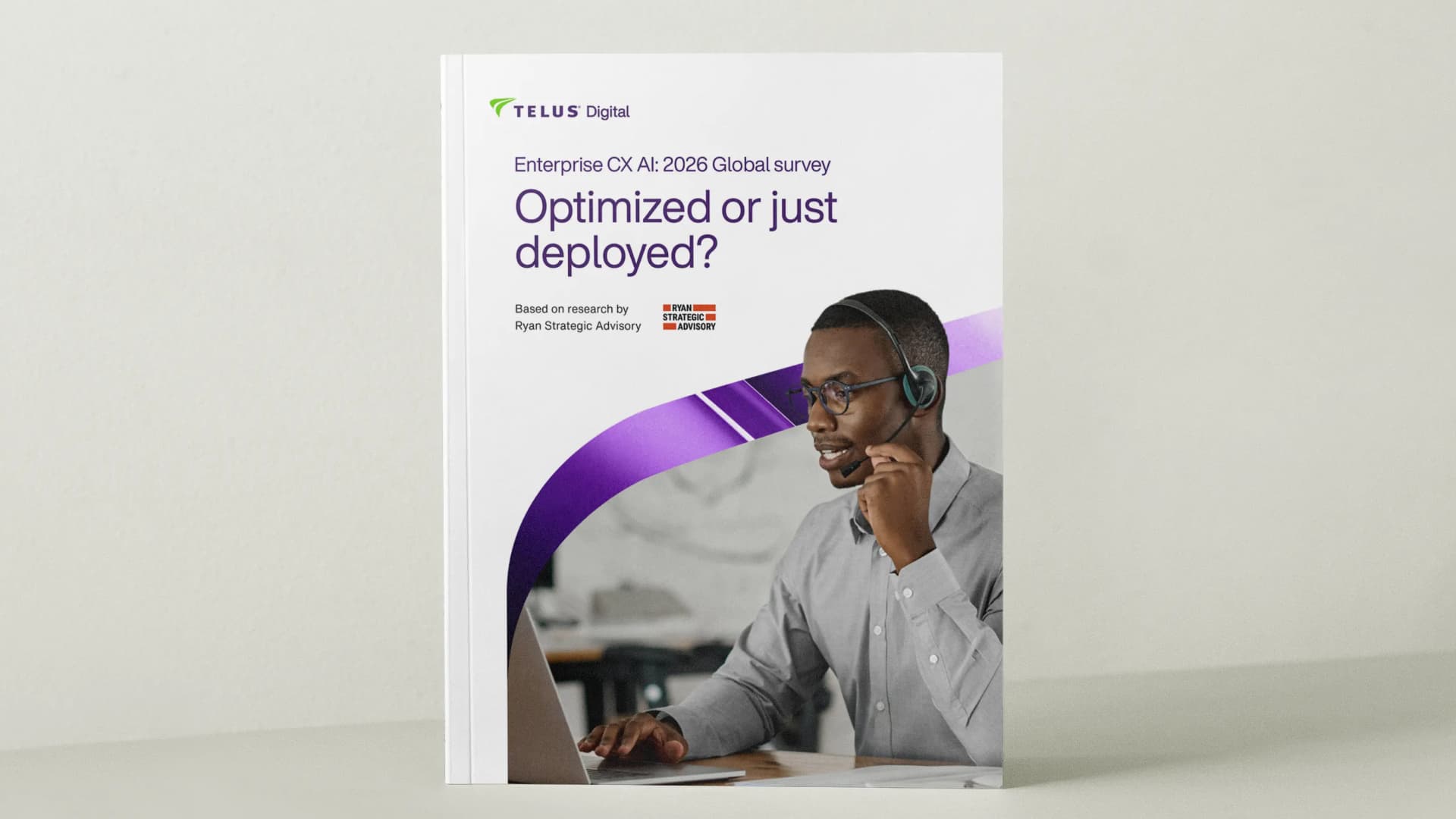
TELUS Digital's 2026 global survey of 815 enterprise CX leaders, conducted by Ryan Strategic Advisory, shows just how far the reality is from AI-only concierge customer experience.
Human agents assisted by AI is the leading model in six of the seven CX functions measured: customer onboarding, billing, technical support, revenue generation, complaint management and customer retention. Concierge services, the premium, high-touch support enterprises give their most valuable accounts, is the exception. It's the one function where purely human-led delivery, with no AI at all, is still most common.
This shows that enterprises aren't rushing to pull humans out of the conversations that carry the most weight. If anything, they're moving more slowly there than anywhere else. That reveals a contradiction and an opportunity. If concierge services is how a company supports its most valuable customers, why are businesses leaving their agents unassisted in the delivery of that support? If the stakes are so high in that particular function, shouldn’t CX leaders be prioritizing it as a function where agents are given the absolute best chances to succeed?
CX function | Human-led, no AI | AI-assisted humans | Fully autonomous AI |
|---|---|---|---|
Concierge services | 44% | 38% | 15% |
Technical support | 30% | 61% | 28% |
Customer retention / winback | 30% | 61% | 28% |
Revenue generation | 20% | 58% | 31% |
Complaint management | 37% | 54% | 11% |
Billing / payments | 41% | 51% | 24% |
Customer onboarding | 34% | 60% | 27% |
Concierge services demand more than a script can offer. It's high-touch, premium support that requires reading a specific customer in a specific moment and adjusting the approach on the spot, something a fixed workflow can’t do consistently. The data shows that enterprises aren't yet ready to trust that kind of judgment to AI alone.
Think of a bank's highest-tier customer, whose relationship manager notices they've become eligible for a benefit they haven't used. Reaching out takes more than a judgment call about whether to say something. The relationship manager has a broader plan for this customer, built on where they sit in the relationship and what keeps them satisfied over the long run, and that plan is what decides whether now is the right moment to mention the benefit, or something worth holding for later. That takes a person who understands the account's trajectory.
Enterprises have moved more slowly, relatively speaking, to bring AI into these relationships than into billing disputes or password resets. These are relationships that take time to develop and understand, and the interactions themselves carry delicate stakes and bigger business outcomes. Getting it wrong costs more than a mishandled password reset ever could. That's exactly why the caution is worth challenging. The stakes that make this delicate are the same stakes that make getting it right so valuable.
That said, I don't expect the human-only mode to endure either. Concierge is more likely headed toward the same model already delivering results everywhere else, which means it will be delivered by human agents with AI at their fingertips.
Concierge might be the clearest use case for that kind of enhancement anywhere in CX, and it's surprising the industry hasn't moved faster on it. Picture an agent taking a call with a top customer already knowing what landed well in past conversations and what didn't, with that customer's full history at hand instead of buried in notes. That’s the same real-time context already proving out in every other function highlighted in the survey. Concierge is simply where it would matter most to sustain and grow valuable customer relationships.
Agents delivering concierge customer experience will benefit from AI assistance
In our survey, AI copilots for real-time agent assistance (56%) and intelligent knowledge management (51%) rank among the top planned investments over the next two years, tools that exist specifically to support the agent. That's the same category of tool already reshaping the other six functions we measured. It just hasn't reached concierge service delivery at the same rate yet.
Peter Ryan, president and principal analyst at Ryan Strategic Advisory, has tracked this shift toward agent-facing AI for years. On a recent episode of TELUS Digital’s Questions for now podcast, that I also joined, titled You deployed AI in your contact center. Now what?, he explained that one of the biggest reasons agents have historically burned out and left the role is the constant toggling between databases and windows mid-interaction. AI-powered tools now give agents a level of accuracy and efficiency, and a reduction in agent effort that would have been "unthinkable even a decade ago,” according to Ryan.
A peer-reviewed study published in The Quarterly Journal of Economics, titled Generative AI at Work, found that agent productivity increased by 15% with the introduction of AI. Elsewhere, HubSpot found that 83% of CRM leaders say that AI makes it easier for customer service specialists to resolve customer service requests. Neither study is about concierge specifically, but they're evidence of the same underlying mechanism: agents perform better with the right tools in hand, and that principle doesn't stop applying just because the stakes are higher.
Examples of how AI-assistance can support concierge relationships
What this looks like in practice depends on the industry, but the pattern holds across all of them: AI surfaces the context, and the person decides what to do with it.
- Premium telecom or utilities: Ahead of a routine plan renewal, AI surfaces that a high-value customer had two unresolved service disruptions last quarter. The agent leads with an apology and a proactive credit instead of a standard renewal pitch.
- Luxury retail or hospitality: A team member handling a loyal guest's request sees a real-time summary of the guest's past stays, preferences and prior complaints, so the recommendation feels personal instead of templated. The same system also surfaces which offers are resonating with similar guests by location or spending tier, so the recommendation is informed by what's working.
- High-value insurance claims: An agent handling a major claim gets policy history and prior claims context surfaced the moment the call starts, along with guidance drawn from thousands of past claims calls on what's worked and what hasn't, freeing them to focus on tone and reassurance instead of piecing the account together mid-call.
- Sports and live entertainment: A season ticket holder with box seats calls about a scheduling conflict. AI surfaces their attendance history, past upgrade requests and lifetime spend, so the agent knows this is a member worth going out of their way for, and can offer a comparable seat swap instead of a standard refund.
- Airline status desk: AI surfaces a top-tier flyer's loyalty history, past complaints and rebooking options the moment a missed-connection call starts. The agent still decides whether to proactively upgrade the rebooked flight or waive a same-day change fee.
Where to start with AI-assisted concierge services
If concierge customer experience delivery is to come from AI-assisted human agents, the first job for CX leaders is to identify which conversations within concierge services carry the highest stakes.
- Name the high-stakes conversations first. These could be renewal calls with long-tenured customers or escalated complaints. Routine, high-volume interactions are where AI-first tools make sense, and where enterprises are already investing.
- Measure the right thing from the start. Metrics like deflection and average handle time can push the wrong incentive here, as these metrics measure whether a customer went away rather than whether their problem got solved. What matters for concierge-style work is whether the customer's problem got solved and whether the relationship grew stronger, the kind of outcome that shows up as improved loyalty and revenue.
- Build with the people doing the work. The tools that stick are the ones shaped by engineers working side-by-side with the customer service team. Forward-deployed engineers in the contact center see firsthand when agents use a tool, work around it or ignore it. That visibility is what turns a tool the team tolerates into one that reduces their effort.
- Make sure the data is real-time and structured. The value of AI in a concierge conversation comes from account history, past interactions and demonstrated preferences surfacing automatically. If the underlying data isn't structured and accessible in real time, no interface sitting on top of it will make an agent more informed than they are.
- Incentivize the right behavior. If agents are still measured or compensated on speed and volume, no amount of better tooling will get them to slow down for the conversations that need it. For concierge service, the metrics have to reward a solved problem and a strengthened relationship.
Top-tier customers still want a human agent they can count on
Concierge services are some of the highest-stakes conversations managed by the contact center. To seize the growth opportunity inherent in these conversations, CX leaders need to think critically about their approach.
Some have argued the answer is AI running the relationship on its own. The market, however, shows that concierge is a CX function still primarily delivered by human agents with no AI. I see this as a false dichotomy.
AI-assisted humans was the dominant model across all other CX functions, and in time, it will prove to be the right model for concierge services too. The businesses building for the opportunity are figuring out how to provide real-time context to agents, being intentional about metrics and incentives, and organizing their data and technical teams so that the best of technology and human expertise translates into customer outcomes.
Ready to talk through what this could look like for your business? Connect with one of our CX AI experts.
Erin Walker
Global VP, CX AI, TELUS Digital
Erin leads TELUS Digital's CX AI practice, operating at the intersection of AI strategy and delivery, focused on ensuring that the outcomes expected by enterprise clients are the ones they realize. Her work spans the full arc of CX AI implementation, from organizational readiness and vendor selection through to deployment, coaching and continuous quality improvement.
Erin leads TELUS Digital's CX AI practice, operating at the intersection of AI strategy and delivery, focused on ensuring that the outcomes expected by enterprise clients are the ones they realize. Her work spans the full arc of CX AI implementation, from organizational readiness and vendor selection through to deployment, coaching and continuous quality improvement.