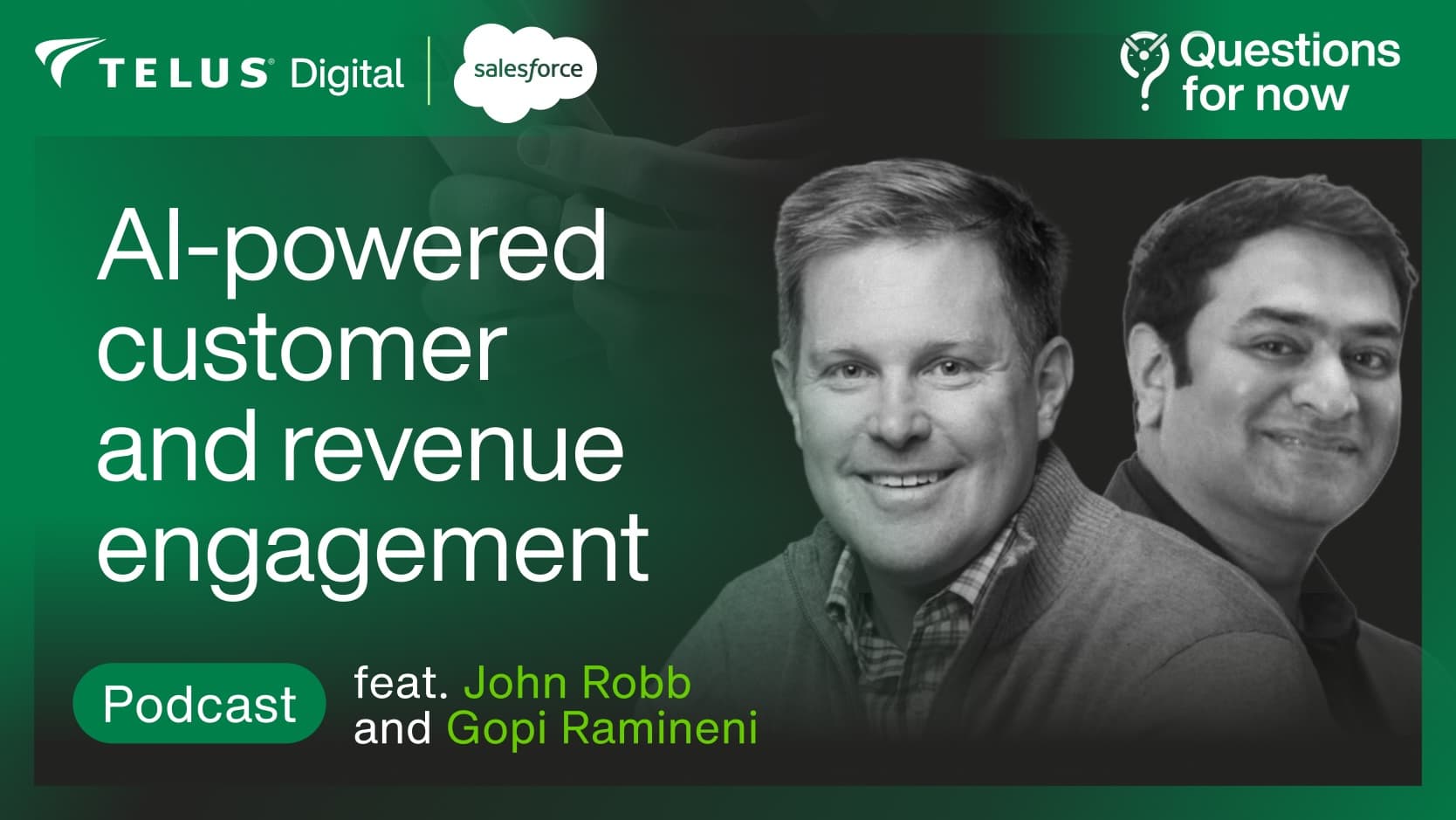
How can agentic AI drive customer and revenue engagement? (feat. Salesforce)
On this episode, we explore how agentic AI is turning the contact center into a growth engine — and how to make that shift without losing customer trust.
Salesforce is framing the 2026 Dreamforce conference around the agentic enterprise: organizations where AI agents handle routine work autonomously so people can focus on what still needs a human.
Salesforce's State of Service: AI Agents Edition, which surveyed more than 3,000 customer service professionals, found AI agent adoption nearly doubled year over year, climbing from 39% to 66%, with Salesforce projecting AI will resolve half of all customer service cases by 2027. That adoption curve is an opportunity for contact centers to move past being a cost center and build a revenue channel instead, a shift called revenue engagement. It means building trust through service conversations, leading to a cross-sell, a larger sale or a stronger relationship.
John Robb, product leader for voice AI and Agentforce Contact Center at Salesforce, and Gopi Ramineni, Salesforce practice leader at TELUS Digital, walk through what it takes to drive revenue engagement. Along the way, they speak about matching AI response speed to what a live caller expects, unifying customer data across systems so an AI customer service agent has the full picture before it acts and tracking a customer's value across their whole relationship with a company to see whether a service conversation is earning enough trust to influence a sale.
Show notes
Register for Dreamforce 2026 and join TELUS Digital at Hotel Zetta, September 15–16, 8am–9pm PDT: https://sfpractice.telusdigital.com/dreamforce-2026
Follow and listen:



Guests
 John RobbProduct Leader, Voice AI and Agentforce Contact Center, Salesforce
John (JR) is a product leader for voice AI and Agentforce Contact Center as part of the Agentforce and Agentforce Service leadership team. Based in San Francisco, JR joined Salesforce in 2024 via the acquisition of Tenyx, a voice AI start up. Previously, JR was the general manager of R&D for collaboration products at VMware and the general manager of document collaboration at Dropbox.
 Gopi RamineniSalesforce Practice Lead, TELUS Digital
Gopi has spent more than twenty years in management and technology consulting. During that time, he founded and built Gerent into a Salesforce Summit Partner. TELUS Digital acquired Gerent in 2025, and Gopi has led the combined Salesforce Practice ever since. Outside of work, he's usually reading, spending time with his family or trying out a new restaurant.
Episode topics
- 00:00 - How does Salesforce Agentforce turn customer service into revenue growth?
- 01:40 - What is the agentic enterprise and how fast is AI agent adoption growing?
- 07:31 - How does sub-second voice latency build customer trust in Agentforce?
- 08:23 - Why is unified data architecture critical for agentic AI customer journeys?
- 13:15 - How does real-time AI assistance improve human agent retention?
- 15:37 - What is the best strategy to deploy enterprise Agentforce solutions?
- 18:47 - How does TELUS Digital orchestrate cross-platform agent-to-agent integrations?
Transcript
[00:00:01] Robert Zirk: Where does your AI stop and your best human agent start?
[00:00:05] That line is moving fast. (sound of a line being drawn) Salesforce expects AI agents to resolve half of all customer service cases on their own by 2027. Make the handoff seamless, and the customer's trust holds. Get it wrong, and the revenue doesn't.
[00:00:22] John Robb (JR): You really want these AI systems and AI agents, whether they're text or voice, to be more deterministic in thinking about: What is the customer trying to accomplish? What's the right interaction for them?
[00:00:35] Robert Zirk: Helping a customer achieve what they're trying to accomplish is what earns their trust in the first place. For strategic CX leaders, that trust creates an opportunity for customer-led growth.
[00:00:46] Gopi Ramineni: They need to start measuring things a little bit differently. First, what is the true value of a customer for life? How do you measure that? And what are the contributing factors that the call center is doing to keep them as a customer for life and repeat?
[00:01:03] Robert Zirk: Today on Questions for now, I'm joined by John Robb, product leader for voice AI and Agentforce Contact Center at Salesforce, and Gopi Ramineni, Salesforce practice lead at TELUS Digital, as we ask: How can agentic AI drive customer and revenue engagement? Welcome to Questions for now, a podcast from TELUS Digital where we ask today's big questions in digital customer experience. I'm Robert Zirk.
[00:01:36]
[00:01:40] Robert Zirk: At the time we're publishing this episode, Salesforce is getting ready for Dreamforce, its annual technology conference. This year, Dreamforce is built around the agentic enterprise, which Salesforce defines as organizations where AI agents work alongside human teams, handling routine work on their own so people can focus on the work that needs them. According to Salesforce's State of Service: AI Agents Edition, based on a 2026 survey of more than 3,000 customer service professionals, the adoption of AI agents has nearly doubled from 2025 to 2026, going from 39% to 66%.
[00:02:21] John Robb, also known as JR, has watched agentic AI adoption climb firsthand through his work on the product teams for Agentforce, Salesforce's enterprise agentic AI platform. I asked him what he's hearing from CX and contact center leaders about where agentic is headed, and it comes down to...
[00:02:39] John Robb (JR): ...thinking about customer engagement and customer journeys more holistically. So thinking about service and sales and end-to-end customer journeys, thinking about how AI can help customers, both in an autonomous as well as a human-assisted way, and then also thinking multi-channel, whether it's voice, text, SMS, WhatsApp or others.
[00:03:00] Robert Zirk: Part of this reframe in how leaders are thinking about customer engagement is something we've covered on the show before: CX leaders turning their contact center into another revenue engine. This is revenue engagement, using the trust built in a service conversation to influence a cross-sell or upsell opportunity.
[00:03:20] Gopi Ramineni, Salesforce practice lead at TELUS Digital, is helping customers test that idea directly, running proof of concept programs to demonstrate how agentic AI can help agents spot and act on those opportunities.
[00:03:34] Gopi Ramineni: The approach that they're actually thinking about is how do they make different streams in their organization? First, primarily, how do they enhance the experience for the customer?
[00:03:45] So everybody becomes care providers, in a way, for the experience, for the customers. But similarly, they're also looking at all channels for becoming revenue generation. They're more eager about looking at their CX call center teams becoming a revenue channel because those teams end up establishing a level of trust with the customers as they're problem-solving, prodding details and everything else, and they establish a certain level of trust by doing all of that.
[00:04:14] What they've seen, at least certain customers doing POCs, is that those agents are caregivers in a way. When they position products that would be better suited, understanding how the customer is using the products and these are extended add-on, upselling, cross-sell, how you want to put it as, they tend to hear more, listen more and the conversion rates are higher in smaller POCs that we've seen.
[00:04:40] Robert Zirk: Gopi's already seeing that trust convert into sales. In early POCs, agents who listen more closely to customers are positioning better suited products and getting higher conversion rates.
[00:04:52] For this to work, revenue opportunities and customer trust have to stay in balance. Push too hard, and a customer who called in for help ends up feeling like they're sitting through a sales pitch instead of a genuine attempt at resolution.
[00:05:08] So the big question for CX leaders now is how to approach making their contact center a revenue-generating channel without it being at the cost of the trust the customer came in with.
[00:05:18] Gopi Ramineni: It's getting the right balance in their process, in their culture that they've built with a customer. I think that is where the thought process has to go in. But enabling anything else as a technology layer, anything else available for that agent to make a sale, those things are easier. It's more about figuring out the right art of how to subtly bring the conversation in.
[00:05:41] Robert Zirk: That trust the call center team builds as they resolve a customer's inquiries is exactly what JR says agentic AI is designed to build on. The first step is to figure out which conversations autonomous AI can handle well and which ones still need a person.
[00:05:57] John Robb (JR): The autonomous interactions are great for narrower use cases, for things like FAQs to help customers get the information they need. In some cases, those autonomous interactions are collecting data about who the customer is and what they're looking for so that when an escalation occurs that the escalation is richer and puts the customer and the agent in position to get them what they need. And then as we think about the human enablement piece, it's about having faster and better experiences so that when you get transferred as a customer to that human agent, that they have the information, they've collected the information and they can help you get an overall better experience and get it faster.
[00:06:40] Robert Zirk: For agentic AI to feel seamless to a customer, JR says high speed and low latency matter throughout the interaction — and the expectations are much higher for voice than for text-based AI.
[00:06:52] John Robb (JR): Is the autonomous interaction moving at the pace that the end customer wants and are you capturing information during that discussion about what they need and what outcome they want? So it's about having a high-quality speed, having the right level of engagement and capturing information from the end customer.
[00:07:10] Robert Zirk: I asked JR what's changed to make real-time personalization on a live voice call more reliable than it was a year or two ago.
[00:07:17] John Robb (JR): The systems are getting faster, the latency is getting better. The quality of the foundational models continues to improve. The balance between providing autonomous AI solutions and AI solutions to the human agents continues to improve.
[00:07:31] Robert Zirk: Salesforce's engineering team is chasing that speed directly on Agentforce Voice. Their internal target is sub-second Time to First Audio, which means ensuring an AI voice audibly responds in less than a second after the caller stops talking. Salesforce's own data shows that if these responses are delayed by anywhere from a second and a half to two seconds, callers lose track of the conversation and assume something's gone wrong
[00:07:58] John Robb (JR): We need, particularly in the enterprise context, in a trusted way, to be more deterministic and more probabilistic about how we're providing solutions and making sure that the customer's getting what they want. And I think it's this mix of improved speed, improved foundational model, improved determinism, which is linked to trust, and then finally, doing that in a way that is both autonomous and human-assisted.
[00:08:23] Robert Zirk: Those technical capabilities can handle individual conversations, but to make the most of them, an AI agent also needs the customer's full history — regardless of the platform it's located in — and that's where Gopi makes the case for unifying contact center data.
[00:08:39] Gopi Ramineni: So the first key thing is who are your personas of the customer? If you put yourself in their shoes, what experience would you want from this entity, right? I think mapping that out is a primary thing, and that's where companies should focus heavily on is, "hey, what experience do you want to create for your customers, your employees, your suppliers, vendors, partners?"
[00:08:56] Once you define that, then look at your business processes that are currently there. Not the perceived business process, but actually what is followed on the ground. That business process, you need to look at it when you connect them. Everything from marketing, your sales, your post-sales, your customer care, they should all be interconnected.
[00:09:17] Once you're able to connect the process in a level that achieves that optimum experience linked to the strategy, then you need to look at the systems. They may not all be on a common platform. They could be on multiple platforms. Look at what those point platforms are. Current states: are they integrated? As part of the process, are they all integrated systems perspective? You need to look at that.
[00:09:39] The ideal way to get to is: How do you create a headless architecture with data that is interconnected? And it's available in real time for a particular user in whichever system they are predominantly working in, but should be able to have access to data from many other systems so they can perform the function better.
[00:10:02] Robert Zirk: What does that unified view of customer data look like when it's working? Gopi walked me through an example that surfaced a cross-sell opportunity for a client of TELUS Digital's.
[00:10:12] To set the stage, that client's customers tend to be between twenty and thirty years old and they prefer self-service and chat over speaking with a person directly. The client already had a basic chatbot in place, one that could pull up information whenever customers searched for something — but it was a reactive approach. Customers had to figure out the right questions to ask before they could get what they needed.
[00:10:36] Gopi Ramineni: In the past, that experience, that individual would buy one at a time as needed without truly understanding all of the capabilities about this product or the product set and what it could do.
[00:10:47] So this client decided to implement an agentic experience where that interaction was more about engagement mimicking a human. So if a human is interacting with that individual, you're asking curious questions to get them to understand what they need, right?
[00:11:06] Instead of being, "Hey, give me some information on this product," we're trying to understand, "Hey I understand you're interested in this product. What are you thinking about using it? What is it? What are your interests?" What it led to was that interaction, instead of it being just a small product sale, it ended up being a larger sale.
[00:11:26] Robert Zirk: From there, the results kept building.
[00:11:29] Gopi Ramineni: Now, it started converting a lot more orders and making bigger orders. So rather than just one, they started to sell a bundle of products and everything else through that conversation. They were able to go directly from the conversation to an e-commerce sale without having a human involved. So the power of their agentic solution led to a revenue-generating event using the care side, where somebody would just look at product information, what is the blueprint for it, what is the specification for it. So that's a compelling thing.
[00:11:59] Robert Zirk: Gopi's next example puts agentic AI to the test on a live voice call.
[00:12:03] Gopi Ramineni: Most of the time when the phone calls come in, usually you go through IVR, all of those things, and it gets routed to an agent that's available, and the agent has those discussions and everything else. What we were able to put together was an agentic voice solution where, when a user called in, we could identify which locale they were coming from, so we were able to set a particular voice that is more helpful for that regional locale. And this agentic solution was able to process and ask questions and get them to something that they've explained, in the past, with a human-led approach, it took a lot of back and forth and everything else.
[00:12:46] With the agentic solution, it was able to pull information from three different systems all at the same time and provide that information. What it did was it did call resolution right there. There were no repeat calls. The customer satisfaction was very high. So what the agentic solution did was it processed what the customer wanted, it equated to similar requests that it's seen and it was able to bring information from multiple systems seamlessly to give what was needed and everything in a secure manner.
[00:13:15] Robert Zirk: Those examples show what agentic AI can do for the customer when it reads the conversation well. And that same real-time attention can also help human agents, giving them guidance and surfacing key information during customer interactions. It's especially beneficial for newer agents who don't yet have the instincts that come from experience handling calls.
[00:13:37] Gopi Ramineni: Usually, the people that get discouraged, once they see some of these interactions are not going well, they think that they don't know how to do it and that's one of the reasons why they leave. So by having this AI agent giving those creative inputs and important suggestions live while you're talking, it's coming on the screen and it's suggesting it, that increases their effectiveness and closure rate, so they are happier and your attrition reduces. The amount of investment you make in the agent is phenomenally then managed because you don't keep churning out people. That's one thing.
[00:14:08] But second, the experience to the customer where you're like nonstop talking to customers all the hour. Context switching also. There's only so much that an agent can do. What this AI does is it becomes your buddy on the call that's got your back and it's looking at all of these things, and it'll give you positive input, says, "Hey, yeah, that was a wonderful suggestion you did." And then suddenly it'll look at the customer reaction and then it says, "Hey, how about you talk about this thing?" I think that assistive approach within this is crucial to make a lot of these agents much better than where they are. They're already phenomenal. And all new agents, new humans entering the workforce, they become effective pretty immediately by using this tool.
[00:14:50] So you have basically your work shadow is what I would call it as, that's with you and providing all of that information like that. I think that is gonna drive a lot more happiness with those agents. They'll be happier. The call sentiment is gonna be happier. If there are real critical issues, they're able to identify and access it, do things better. This will prevent attrition, improve customer satisfaction. So this agentic solution, heavily more internal for the human call center agents and also external, is gonna drive a revolution. And that stepping stone will also quickly convert your call centers to revenue influencing channels far more and revenue generating channels as well, both on the self-service side and through what is gonna be available for the human agents.
[00:15:37] Robert Zirk: Think about the wins we've heard about up to this point: fewer repeat calls, a larger sale and agents who stay longer and ramp up faster. Getting there took more than haphazardly layering AI on top of a customer experience operation. I asked Gopi what sets an effective deployment apart.
[00:15:56] Gopi Ramineni: You need to think of AI in the perspective of, "Hey, how do I look at AI that can help manage operations, bring more efficiencies? How can it be more of a tool for individuals to perform their tasks, like mundane tasks, quicker and better or even automate that, and give the humans more time to have more interactive conversations with other humans that leads to better experiences and better results and everything else?"
[00:16:26] When I keep hearing from customers, "Hey, we just deployed this massive AI thing into a call center," the first thing I ask them is, "Okay, why did you deploy it? What are you measuring on? How are you gonna define success? How are you gonna look at ROI?"
[00:16:41] You should never take AI and say, "Put it on this." You need to look at simpler things. You can use AI just for a simpler task like, "Hey, consume all this information, summarize it for me." It's a simple value add right there. Something that would take fifteen, twenty minutes, now it's a two-minute component. You need to make it smaller, incremental and bring it in.
[00:17:01] And then you really need to have a strategy on AI. It becomes a part of your workforce. It's like an additional workforce, the way you really need to think about it. I tell everybody to look at AI agents as extremely intelligent interns so you are guiding them and they perform extremely well and they also continue to learn, so their effectiveness improves significantly in a matter of hours and days rather than years.
[00:17:28] But it all has to measure to something you're trying to improve and something you're trying to gain. It can't be cost-cutting. Cost-cutting could be a result of something that you've done successfully, but that should not be the primary driver.
[00:17:41] Robert Zirk: JR sees the same pattern from the product side, having worked with CX leaders as they deployed Agentforce Voice and Agentforce Contact Center. He shared what he's taken away from those experiences.
[00:17:54] John Robb (JR): Start small, start with specific use cases, make sure that you're thinking about the end-to-end journey, both the autonomous and the human interactions, and make sure you have the right measurements in place so that you can start to think about how you want to iterate and drive results.
[00:18:11] A common mistake is boiling the ocean and trying to end up building too much in the early versions of either a voice or text-based AI solution. And you start with a specific set of use cases. In many cases, you're doing that based off of your current IVR, your current agent experiences, really trying to think about what is it that you have today, what are the metrics today, and what are your goals to build something better going forward and how will you know in that first iteration or the second iteration that you're achieving or improving the results in a way that is in line with both your customers and your business goals.
[00:18:47] Robert Zirk: Achieving results with agentic AI requires orchestration across several platforms, and Gopi outlined how TELUS Digital helps clients address that challenge — when CX teams have several systems running that need to communicate with one another.
[00:19:02] Gopi Ramineni: We have expertise across most of the call center technology, let's say the CCaaS telephone technology. We have expertise in most of the CX technology, which is Salesforce, ServiceNow, Zendesk, all of those other things and everything else. And we also have expertise with strategy. We provide the people, everything else that's in there.
[00:19:20] Now, when we look at an implementation, especially with the agentic framework, our approach always has been to do agentic to agentic play, so agent to agent play. So if somebody's already pre-built agents on their operational systems and we are implementing Salesforce and their call center team is going to reside in Salesforce, so that's gonna be their system of engagement, well if they need to get data from another system using an agentic experience, we don't need to now build that thing ground up using Agentforce in Salesforce to go connect to those systems and bring in.
[00:19:54] What we guide is, through Salesforce, Agentforce can call on the pre-built agent for some of the solutions that they're using for that user group.
[00:20:02] Robert Zirk: I asked JR how working with a partner like TELUS Digital can benefit organizations looking to become an agentic enterprise.
[00:20:09] John Robb (JR): Our top partners like TELUS Digital, what they really bring are this combination of contact center CCaaS capabilities where they understand telephony, they understand what contact center solutions have looked like. And then they've added these new capabilities about understanding AI and agent systems and understanding the new headless capabilities we've launched as well. And I think that this is the magic combination for our partners that our customers have been looking for.
[00:20:37] And TELUS Digital has that with both the ability to understand the contact center, understand the CCaaS market, combined with AI, the new AI and headless solutions as well.
[00:20:47] Robert Zirk: Gopi outlined the next step CX leaders need to take if they want agentic AI to turn their contact center into a driver of revenue engagement.
[00:20:56] Gopi Ramineni: One thing that they should definitely stop doing is measuring things only on first call resolution, where you're using repeat calls. That drives a different kind of mentality. You'll need to really start thinking and measuring around how much is your team helping to increase the relationship quotient of your customer with your company.
[00:21:21] The call center should also have, potentially going forward, some revenue influence targets and actually revenue generation targets where, what we are talking about is, whatever they're having conversations and everything else, and if they're influencing, that leads to a revenue-generating event, whether digitally or through some other channel, but it looks at the influence, would be a key way to justify some of the cost center attributes with that.
[00:21:47] And the second most important thing is the target for revenue generation on their own, where they're able to close the deal on their own, should also start. And they should start with a smaller percentage and start improving and then see how it makes and how you've trended, because you don't want to tilt the scale where the performance of the agent is heavily based on the revenue generation, then the caregiving takes a back seat.
[00:22:08] Not everybody that is customer caregiving can become a revenue influencing, revenue generation person. So you'll need to first identify the talent that are comfortable doing all of those things and know how to do all those things. It's identifying the talent and then try with that group driving success and then you need to cross-train your other team members on how to do it.
[00:22:30] Robert Zirk: JR's closing advice looks toward what you're building with agentic AI, starting with whether the voice experience you're designing still looks like the IVR system you inherited.
[00:22:40] John Robb (JR): Where can you start small? Where can you get an early win, early success and really being narrow and thinking about what are some problems you have today? Where are some metrics you want to improve? So where can you start small and get an easy win and iterate and make sure you get an early win.
[00:22:56] And the second part of that is thinking about your customer experience as to how you wanna provide something new. You may have built an IVR system over the last few years or years ago.
[00:23:07] So I'd say start small. Dream big about what could be done and be ready and excited to be innovative about providing new experiences as well.
[00:23:16] Robert Zirk: And to wrap up, I asked Gopi what he'd want a CX leader thinking about on the way to Dreamforce this year.
[00:23:22] Gopi Ramineni: When you're coming to Dreamforce, as you board the flight to get to San Francisco, what you should be thinking about is with the advent of how AI and a lot of other things are moving fast, how do you think about making your enterprise an agentic-driven enterprise? And Salesforce is a key part of it, and you'll need to start thinking, "Okay, how do you do agent-to-agent play?" Start thinking about it, look at the sessions around it, go there. Even internally, you need to start thinking about, "How do I change this cost center more to a revenue influence center, revenue gen center?"
[00:24:02] Robert Zirk: So that's the shape of the answer to today's question: how agentic AI can drive customer and revenue engagement. It's what we talked about at the top: AI handling the routine work, freeing people up for what only they can do.
[00:24:17] Do that well and the trust it builds becomes something CX leaders can measure and monetize.
[00:24:27] Thank you so much to John Robb and Gopi Ramineni for joining me and sharing their insights today. And thank you for listening to Questions for now — a TELUS Digital podcast.
[00:24:38] If you're heading to Dreamforce 2026 in San Francisco, TELUS Digital will be at Hotel Zetta on September 15th and 16th from 8:00 AM to 9:00 PM Pacific Daylight Time with sessions, demos, networking events and our team on site to talk through industry transformation, AI strategy and connected customer experiences.
[00:25:02] To register, visit our Dreamforce page at telusdigital.com/events. The link is in the description as well. We'd love to see you there!
[00:25:11] And if you enjoyed this conversation, follow Questions for now wherever you listen to podcasts so you don't miss what's next.
[00:25:19] I'm Robert Zirk, and until next time, that's all... for now.
Follow and listen:
Frequently asked questions
Agentforce is Salesforce's enterprise agentic AI platform, spanning products like Agentforce Voice and Agentforce Contact Center. It lets AI agents work autonomously across voice, text and other channels, and assist human agents with real-time information during live interactions. Salesforce's AI Agents Edition of its State of Service report found AI agent adoption nearly doubled year over year, from 39% to 66%.
Generative AI creates content, such as a response or summary, based on a single prompt. Agentic AI goes further. It plans multi-step actions, calls on other systems and tools and adapts as new information comes in, chaining those steps together on its own and handing off to a person when a task calls for one.
AI customer service agents handle or assist customer interactions using natural language processing. Some resolve requests autonomously, such as answering a routine question, while others work alongside a human agent, surfacing relevant information and next steps during a live call or chat. Salesforce projects AI agents will resolve half of all customer service cases by 2027.
Contact center AI agents can capture buying signals during routine service conversations. TELUS Digital has seen a reactive chatbot rebuilt as an agentic experience that asks customers about their goals rather than waiting for a specific request, turning single-item purchases into larger, bundled sales for one client.
Response speed shapes whether a caller trusts an AI voice agent. Salesforce's engineering team targets a Time to First Audio of under a second on Agentforce Voice calls. Their own data shows that response delays of a second and a half to two seconds cause callers to lose track of the conversation and assume something has gone wrong.
Effective agentic AI workflows start narrow. Rather than rebuilding a contact center's technology from scratch, TELUS Digital connects pre-built agents across the platforms a business already runs, such as CRM, telephony and case management, so an agent-to-agent handoff can pull the right data without new infrastructure for every integration.
First-call resolution measures speed but misses revenue. CX leaders can instead track a customer's value across their full relationship with a company, along with whether service conversations are earning enough trust to influence a sale. That shift changes what counts as a good outcome for both the agent and the business.
A strong Salesforce implementation partner combines contact center and CCaaS expertise with agentic AI capability, so a business is not building agent-to-agent connections from the ground up. TELUS Digital brings both and will be at Hotel Zetta during Dreamforce 2026 to walk through what that looks like in practice.
Explore recent episodes